Time Magazine has put together a collection of the 50 coolest websites of 2005!
The full list can be found at:
http://www.time.com/time/2005/websites/
Time Magazine has put together a collection of the 50 coolest websites of 2005!
The full list can be found at:
http://www.time.com/time/2005/websites/
Turns out Donald Trump doesn’t just have an online university, but he also has his own blog – which gets plenty of comments, heat and feedback *sniffs*
Of all the Internet buzzwords, E-business is perhaps the most mis-understood. We see e-commerce every day. From e-bay to Amazon, e-commerce allows the consumer to buy, sell and pay for products and services online. We also see e-marketing from search engine results, from e-mail lists and viral marketing campaigns.
But what about e-business? What is it, and why should you care?
Here are a list of great questions, openings and closing statements that you can use in your business.
Ive taken most of these from Guerrilla Negotiating, and the 250 Sales Questions to Close the Deal;
Meg Whitman, CEO of eBay, is listed as the #1 most powerful women in business, according to a list prepared by fortune.com
“The empress of eBay still rules Silicon Valley. Though the stock has had a tough year, down about 30%, revenues and profits are strong. To keep eBay expandingit now has 68 million active usersWhitman has gone shopping, buying seven new businesses for more than $1.3 billion. Up next: the controversial $2.6 billion acquisition of Skype.”
The list also includes, Anne Mulcahy – CEO of Xerox and of course, Martha Stewart – Founder of Martha Stewart Living Omnimedia.
See the full-list of the 50 most powerful women in business
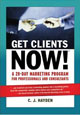
One of things I really hate about marketing books is that they dont tell you how to market.
Rather, they all tell you all the various tactics that you can use but they dont tell you when, how, when or why.
The worst books, in my opinion, are the academic books which you can get in any library which have detailed theories with diagrams but they dont tell you what to do, how to do it, how much to spend.
Not one marketing book Ive seen to date answers the question What can I do *right now* to help my business attract more leads, increase sales and get more customers? — except, that is, until I read Get Clients Now!
If youre just about to start a business, you may be overwhelmed with the amount of things you have to do. Running any marketing campaign (regardless of size) takes time, money and effort and its almost impossible to decide how much to spend, or how much time to use.
This is where Get Clients Now! comes in. Get Clients Now! is a 28-day programme that you can use on a daily basis to see where you are, and help you get where you want to be.
Whats great about this book is that it feels like it is written as a business coaching exercise, complete with lots of worksheets that help you today!
The book starts by explaining the 6 different marketing strategies that are available to most businesses and the value of their effectiveness.
These six strategies are
There are chapters dedicated to the marketing/sales cycle as well as setting your own goals based upon the following:
The book then launches into outlining ‘The System’ a 28 day marketing program that is geared towards increasing your bottom line.
The last part of the book focuses on strategies for specific problems you may be running into with implementing the system.
The whole book is around 10 chapters and about 200 pages.
The 28 day program offered by Get Clients Now! can be repeated as many times as you like; remember the 28 day program is actually written by you, not the book but it is really important to keep a log of your success
What I really like about this book is that it demystifies generic sales & marketing theories and gives you a systematic approach that you can follow.
I wish I had this book 30 days ago, it has many worksheets that can be printed off and can be stuck on a wall so you can track how you are doing; much like a Project or Gantt Chart
I think Get Clients Now! is great for start-up companies, and sole-traders in the service industry – and I would definitely recommend it to anyone who wants to get a step-by-step guide to sales, marketing and getting more clients.
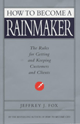
I’ve waited quite a while to file a review on “How to become a Rainmaker” because I’ve often read books once, but this is perhaps the only book I can remember that I have read more than 5 times.
Written by Jeffrey J Fox, the best selling author of “How to become a CEO”, this book is an insightful look at how to dollarize, how to quantify business benefits and how to get and keep customers.
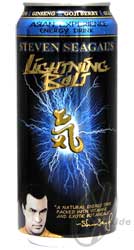
Are you stuck drifting through life in a state of existential confusion wandering aimlessly through the multitudes of energy products not knowing which one is the right one for you? Then look no further for the true meaning of life then Master Sensei Seagals Lightning Bolt Energy Drink!
Lightning Bolt, the one and only energy drink crafted by martial arts expert and herbal specialist Steven Seagal, is the only all natural 100% juice energy drink on the market. This long lasting energy elixir is made with key ingredients from all over the globe. With a healthy dosing of Tibetan Goji Berry, Asian Cordyceps, B-Vitamins, Green Tea, Yerba Mate, Ginseng, Ginkgo Biloba, Guarana, and Policosanols, Lightning Bolt will give you the strength you need to punch your adversarys faces through plate glass windows day in and day out!
Oh and it gets better, Steven Seagals Lightning Bolt is available in 2 great juicy flavors! Cherry Charge brings you the great taste of freshly squeezed cherry juice, while for those of you that desire a slightly less sweet drink can partake of the true Asian Experience. Either way, you still get a powerful bolt of energy delivered into your body that Steven Seagal precisely blended for lasting maximum performance. So get ready to take on the world with new meaning with Steven Segals own Lightning Bolt Energy Drink!
Features:
Specifications:
“Dear sir,
I recently saw your website, read some of your articles – which I think are very well written, but the thing is – I run a very small business and I don’t think any of the things you say are actually practical. Running a small business is time-consuming and it’s expensive, I don’t have the time or money to “think big” – how can a small business think big on a small budget?”
That’s a great question.
Thinking big is seen by many as something done by big companies, by marketing gurus, by people who write blogs – or people who may or may not have had the experience of actually running a small business.
I know from personal experience that running a small business is time-consuming and it can be very expensive to run, to operate and yet still have the time/money to think big.
Think big doesn’t mean “Oh I can do this too, and I can add that” — most businesses don’t have the capacity to do more than what they offer or provide – what think big means is how you can deliver more, how you promote better, how you work smarter.
The most crucial aspect of thinking big that people forget is — “is it actually practical?” — “can we actually do this” and “how do we do this?”
Recently a colleague of mine had a great street-smart marketing idea to promote resturants – he thought big about how to promote it, about “catching the big fish” – but once I asked “how do you actually deliver it?” he stared blankly – as if it were somebody else’s job to help deliver it.
If you say you can do a particular job and then can’t actually deliver it, that’s not thinking big at all – it’s called “winging it”.
Thinking big must be practical – sure shoot for the moon, think about going nationwide, think about going global – think how much you can make and think about how many contacts you will see — but always think “okay, this is the idea – how do we actually deliver it”
So, getting back to the question — how can a small business think big on a small budget?
Well, think big on low-cost ways of marketing, and promoting your business… think big on attending at least 1 or 2 networking events, and put a budget on it and ask is the investment worth the hassle.
It might be that you can’t do it, or it’s too expensive or the risk isn’t worth the investment – you can always do it later, you can always downsize your idea or do it bits.
To think big doesn’t mean you think without rules, without a budget — all you need is an idea and know how to deliver it – be it advertising, promotions or marketing.
In short, a small business *can* think big – simply choose one area you want to think big, be practical about the idea, then shoot for the moon!
In Sham : How the Self-Help Movement Made America Helpless Steve Salerno makes a blistering critique of self-help books, gurus and “programs” – claiming that the predatory and fraudulent practices of self-help books have corrosive effects on society, and that they cause more harm than good.
Salerno has a great point. Self-help books don’t help. Putting faith into self-help books to “empower” your growth away from “victim-hood” is a not a path at all, rather its an addiction.
Believe nothing, no matter where you read it, or who said it, no matter if I have said it, unless it agrees with your own reason and your own common sense.
— Budda
SHAM which stands for The Self-Help and Actualization Movement, is a $8-billion-a-year industry that depends on legions of repeat customers. I think that statement is true. You buy one book, you feel good — for a while — then you feel bad again and go out and buy another one, or buy the audio-program because you feel, in some-way, in-efficent.
One of the many people Salerno exposes is the the “hypocrisy” of Dr. Phil (who, psychologists say, shames rather than helps his guests) and Dr. Laura (the preacher of family values who didn’t know when her own mother was murdered), among many others. He cites examples of “junk science”, such as Tony Robbins’s talk of “the energy frequency of foods,” and charges that untested alternative medicine draws people away from proven medical treatments.
Salerno argues, quite rightly, that self-help does not cover the real problems underpinning our problems – we never really solve the problem, rather self-help books bate-and-switch us into believing that our solution is that we don’t take responsibility, or that we don’t accept accountability, or that we don’t feel loved.
Some of the stuff in the book is laugh out loud hilarous and Salerno arguments are well structured and documented clearly and understandably. One of the many problems with this book is that some of the arguments have a “yes, but…” tangent to them.
For example, I don’t believe Napoleon Hill should be blamed for all the self-help books out there. He wrote his book in the middle of the depression and is an excellent read. I don’t believe that all self-help books are junk, Krishna, Qur’an, and Budda’s teachings are excellent — but they aren’t called self-help books, rather they are based on teachings, ideals, faith and religion.
SHAM is a good read, and has good arguments on the “faith” people put into the SHAM industry and how it exploits them.
One of the things I wondered when I read SHAM was whether SHAM, just another self-help book in disguise? Is SHAM a sheep in wolf’s clothing? To be honest, I do not know — it is certainly has some good, worthy arguments – and is probably worthy of a better read one day.
In the end, self-help books don’t help people – people help people. You don’t *need* a self-help book to get help, if you need help – ask for help!
If you still need help but didn’t ask – and still rely on self-help books to get you where you want to be then you’ll never get there.
Overall: 6/10.
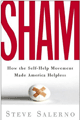 Buy this book from Amazon