Blog

  • How would you move Mount Fuji?

    What is it with zany job interviews and why are they suddenly en-vogue?

    “There are lots of reasons for interviewers to ask a weird question – to see how fast a candidate can think on their feet, to gain insight into their personality, or to gain an idea of their thought processes.” says Mat Jackson of Manpower.

    Rather than asking if a candidate whether they are qualified, job interviews ask silly questions.

    “One job seeker was told to talk to a teddy bear, while another was asked if he knew how it felt to kill a man…” claims a BBC news article.

    Ever since Microsoft made headlines for its unconventional approach to interviewing, more and more companies are looking for that certain approach that will uncover just the right quality of mind, despite them have little, if anything to do with the job.

    In the book How would you move Mount Fuji?, it lists some of the more wierd questions that Microsoft and other big businesses are using.

    To get a job, it would seem you need to think of the most unexpected questions… but, I mean really — who gives a damn whether or not you can move Mount Fuji or not?

    Walking the talk

    More and more companies use tests, exams to see just how good you are. Even smaller companies or one-man-band’s need to know that you can do what you say you can do… they want to see you “walking the talk”…

    In the new media and website industry, companies increasingly ask you to do a test: design a website for a client, or design a logo, write compelling copy for a client, etc, etc…

    This kind of questioning, testing process might anger, frustrate and annoy many job interview participants — the idea of being more entreprenuerial than the next job applicant is not a new one, and all it needs is a spark of creativity, a “think big” attitude.

    The 5 assets of any business

    Before you apply for any job, think first of the 5 assets of any business – which one of these are important for a business? Which one would you be most concerned about when applying for a job?

    1. Financial assets
    2. Physical assets
    3. Intellectual assets
    4. Human assets
    5. Social assets

    Of those, the most important asset is the social one. If your company/business or potential next employer doesn’t share the same social assets or philosophy as you do then ask yourself “why should I work for this employer?”

    Once you’ve fulfilled that asset you can really shine at an interview regardless of whether or not they ask “stupid” questions.

    But what happens if you don’t have a choice about the social asset? What happens when you need a job so badly that it hurts? How do you stand out?

    If you really want to shine in an interview, in a job…the answer is simple, don’t treat it like a job… be more entreprenuerial than the next guy/girl and be open to the idea that you *can* and will make a positive impact for your next employer by thinking big, think about the benefits you can bring to their business (not what you can/will do), think about the finanical assets you can improve, think about the physical, technical, intelliectual and human assets you can improve upon, use bottom-line language and fresh ideas like the cardboard cut-out idea

    In the end, a job is only a job if you feel it has no value to you. A job becomes much more than that (regardless of any question asked of you) when you believe it is worth more than the numbers printed on your pay-cheque.

    More Resources

    More on Microsoft Interview Questions
    More on the Interview process at Microsoft
    Google search on Microsoft Job Interview Questions:

  • Myths of Entreprenuership

    So, you got a small business, its up and running (finally) — does this make you an entrepreneur? What is the difference between running a business and being an entrepreneur — and does it really matter?

    According to the highly acclaimed book “The E-Myth Revisited: Why Most Small Businesses Don’t Work and What to Do About It” by Michael E. Gerber as well as the many other E-Myth books that Mr Gerber has written — a small business isn’t the same as being an entrepreneur.

    IDEA #1 – There is a mythI call it the E-Myth – which says that small businesses are started by entrepreneurs risking capital to make a profit. This is simply not so. The real reasons people start businesses have little to do with entrepreneurship. In fact, this belief in the Entrepreneurial Myth is the most important factor in the devasting rate of small business failure today.
    — Michael E. Gerber, The E-Myth Revisited.

    According to the E-Myth you should be building a business that you can either sell at a great profit, or a business you can franchise and again sell off your success formula.

    The concept of the E-Myth is that most businesses are not started by entrepreneurs, but by people with a skill or passion and that most they fail because they remain in the technician’s mindset, instead of learning to think like an entrepreneur and a manager.

    But what other myths are there?

    (more…)

  • 7 principles for a successful website

    What makes a website successful? If youve ever asked yourself this question, youre not alone there are many people who wonder what makes a website successful.

    There are many components of a successful website. Here are just 7;

    1. Content
      Although debated by some whether or not content is important. If youre selling suits online, you need to educate your customers why your suits are the best. If youre selling train tickets online you optimise content to increase people to buy the tickets content is still king in my book.
    2. Search Engine Readiness
      Making your website easy for search engines to trawl, record and utilise your site. The ranking and optimisation of content and keywords for search engine readiness is one of the corner-points of a successful website.
    3. Customers
      If you dont have visitors and prospective customers then your website and business is suffering and you need to promote the site more effectively.
    4. Communication
      What does your website communicate to your audience? What should it look like to help communicate the website better?
    5. Metrics
      How are you measuring the success of your website? Forget about hits. Concentrate on page views, unique page views, subscribers, returning subscribers, number of purchases, number of sales, and number of clicks on article/e-zine. If you’re website is making you money you can help improve your website by concentrating on 1 or 2 things you are interested in measuring, recording it every week and then evaluating it every month. Remember to ask yourself how can I improve the numbers coming to my website?
    6. Promotion
      How are you promoting the website? If you are not promoting the website, this may be the cause for your lack of website success. You need to promote your website everywhere, anywhere, and anyhow. Combine traditional marketing with online promotions. Use promotion to help attract prospects and turn them into customers. Use promotion to help turn customers into loyal ones
    7. Purpose
      What is the purpose of your website? Is it to inform, and articulate debate? Is it to give customers a phone number to call? Do you want them to buy things from you? Knowing the purpose of your website is important because without it you may make critical mistakes that impact on its overall success

    You may rank one thing higher than another. You might already be saying He forgot about X, Y and Z thats good. It means that youre thinking seriously about the success of your website and how to improve it.

    Now get a pen, a piece of paper and write the things you feel are important for the success of your website, then ask your web designer hard questions regarding each part.

    These answers will then help you focus your mind on how to improve your website even more!

  • What self-made millionaires really know, think and do review

    Buy What self-made millionaires really think, know and do

    “I really loved this book, its the perfect compliment to Think and Grow Rich…”

    With a title such as What self-made millionaires really think, know and do you might be thinking that this is a book about how to become a millionaire and whilst the book does cover some excellent practical hints and tips on how to actually do it that isnt the real theme of this book.

    Unlike other NLP/self-help books it leans towards the business side. Of all the practical business books Ive ever read I believe this book offers the best value in terms of business because it covers the widest range of ideas, concepts and values.

    Much like Napoleon Hills Think and Grow Rich, this book covers a lot of subjects from How to think creativity, the definition of success, what strategy is and how to use strategy to get where you want to be, how to use marketing, how to improve your sales skills, how to negotiate better, how to become a great leader, how to understand the bottom line and how to use your time effectively and thats just a brief overview of the contents of this book.

    At 308 pages long the book is surprisingly easy to read with a good choice of typography and well spaced lines theres nothing I hate more paragraphs too close together and making it harder to read, understand and digest. This book offers excellent ideas and expands on them easily, without hyperbole.

    The only issue for readers might be the strategy side because the book covers the Boston Matrix and some people argue that the Boston Matrix strategy is out of date and we should be using the Ansoff strategy and the book doesnt say why it uses one strategy concept above another.

    This book offers an overall depth of expertise from its co-authors in a concise and direct manner. Clear language and structure convey powerful messages with practical strategic tools that will leave you empowered, and well-informed.

    Why is this book so good? I think its because it really offers practical advice it is clearly written, concise and a joy to read on a Sunday. The quality of the content is a great compliment to Think and Grow Rich and offers the reader a chance to focus on key business ideas, goals, objectives and values to take forward to tomorrow.

    Overall Id give this book 9/10.

    Buy what self-made millionaires really know, think and do from Amazon

  • Donald Trump University?

    When I first heard of the Donald Trump “University” I thought it was a really cool way of giving back to the community – a social enterprise to help teach success, and what it means to be entrepreneurial in life, at work, at home and in business.

    However the site isn’t really a University – rather its a collection of audio, video, multimedia and e-books that you’ve probably seen a lot of on the Internet from various factions.

    I don’t live in the States so I’m not actually sure if the Trump University actually exists or not and I’m surprised to hear that Trump didn’t want to get involved in education.

    Perhaps, like the old Chinese kung-fu masters, he’s doesn’t want to revealing everything in fear that a better student may overthrow him – which I can understand and totally respect.

    There’s a lot of funny copy on the page, including “I invite you to do business with me.” — hmm, I wonder how open that statement is…

    Anyway – check out the Trump e-University, maybe you’ll pay the $39.95 for the entire collection – if you’ve already bought the set and want to write a review, please contact me I’ll be delighted to post a link to it.

  • Can 8 men in a room really make poverty history?

    The Live 8 event was, in my opinion, a fantastic world-encompassing I watched it on the BBC digital service, allowing me to track back and forth from the events in London, Philadelphia and other events at a press of a button.

    I really liked the Philadelphia event, I was very surprised to find out that Def Leppard was still around and I found the Linkin Park bit superb! I also enjoyed flicking over to the African event at the Eden Project it was very lively and exciting.

    The London event was certainly the place to be for the many revellers, although I do have reservations about certain performers.

    For example, Jimmy Carr why the hell was he there? His cynical, Its all about me deadpan face was not necessary at this event.

    I ended up yelling at the TV this is a serious event and your trying to make light of it, what the hell is wrong with you?! Which was strange, because I wasnt even drunk. Come to think of it, I dont even drink.

    Why was Jimmy Carr and Peter Kay there? This was meant to be a serious event and they’re making light of it and trying to milk it for their own comedy routine!

    Another performer I didnt like was Peter Kay sure hes funny but whats he doing there? His introduction of The Who as The Spice Girls was unfunny, patronising and down right rude

    (more…)

  • The fall of Jackie Chan

    In the early nineties I was one of those few bored teenagers that were hooked on the stylish Hong Kong action movies that seem to make Hollywood action movies look pale in comparison.

    Whereas Hollywood focused on big pyrotechnics and extravagant stunts laden with CGI and special effects Hong Kong had dramatic undertones often utilising specialist stunt techniques that often made the protagonists look super-human and yet, so very cool.

    So why did it all go so horribly wrong, and who is to blame?

    (more…)

  • It came from the 80’s!

    Do you remember those teenage movies from the 1980s? Remember how no film seems to recapture that time as well? Remember how the movies seem to capture moments in montage moments that stirred the soul?

    Movies such as Ferris Bueller’s Day Off, Back to the Future and so forth were the embodiment of my childhood and early teens. The movies that had montage moments were also cool.

    So lets look back at some of the movies that had stirring montage moments that were decidedly hammy:

    (more…)

  • Star Wars Episode III review

    This will be the last movie I see in a cinema I declared to somebody in a cue standing anxiously in line, impatiently waiting to watch the last in George Lucas Star Wars Pre-trilogy. It wasnt because I hated the film, but it was because over the past few years cinema tickets in my local area has increased something like 20-25% within 6 months and I was determined not to be suckered into another movie hype-fest like Charlies Angles *(shudders)*

    Yeah, but this is the movie where we get to find out why Vader said You should not have come back in A New Hope plus we get to see why Vader turned to the dark side! replied the colleague, who by now had drank all of his 2 litre Pepsi soda which he was saving for the movie.

    Somehow I sighed I get the feeling this is going to be like Titanic, where you know whats going to happen in the end. I retorted, looking at my watch.

    When we finally got in, I sat near the front which was really my mistake because it took forever for my eyes to focus on the big screen but that didnt matter.

    By the end of the movie I felt it was neither bad, nor good it was sort of in-between. I liked it, it wasnt too bad it sure made up for the previous two Star Wars films where nothing really happened.

    The things that really brought it down were the sub-par story-telling and poor lines delivered with wooden performances, especially by Hayden Christensen who for some reason looked like he was on drugs.

    Ian McDiarmid plays the insidious Supreme Chancellor Palpatine with a hefty dump of cheese and relish not seen since Return of the Jedi, and I think this is really a movie about Palpatine, not Vader.

    I was also disappointed how we didnt see or hear much from Vader. His reasons for turning to the dark side are okay, but I dont think it was really enough to value his fall from good to evil. Although having said that Vaders sub-par delivery of comedy value of Vaders cry of NOOOOO! will probably go down in history alongside Kirks KAHHHHHNNN! and Brandos delivery of STELLLLAA!

    Overall Star Wars III, in my opinion, wasnt a bad movie it wasnt a good movie it was fun, it was interesting and it was the best of Lucas pre-trilogy.

    Overall, I’d give this movie: 6/10.

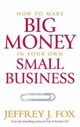
  • How to make big money in your small business: Review

    Buy how to make big money in your own small business

    “Although not as good as Rainmaker, this is a easy to read book…”

    Jeffrey J Fox is the bestselling author of “How to become a Rainmaker” and “How to become CEO”. Fox has won numerous awards from the business community and is highly rated as one the top 100 marketing gurus in the world today.

    In his latest book, Fox writes a concise and practical guide to the elements for success for every small business owner.

    The book, which is 150 pages long has a title that doesn’t really reflect what the book is about — in fact, it doesn’t actually give you any new ideas on how to actually go around to make big money from your small business.

    Rather, this book is about the *responsibility* each business owner must fulfill – and describes what the rewards for sacrificing time, money, assets and resources will bring.

    The concise nature of this book may upset many because it is little on detail and can be described as simplistic. If you’re starting a business you’ll find this book is more of a “pick-me-up” – it drills down business into two/three small pages.

    Personally, I like this concept – and its almost unique to Fox’s books. Personally, for me – this book gets to the heart of the matter, quickly, effectively and promptly.

    Fox does provides quirky insights and ideas on how to be successful, for example – he explains why you should “hire an ex-paperboy” instead of a University graduate – and how “picking up paperclips ” can save you money.

    Unlike Rainmaker, I don’t believe this is ‘essential reading’, but it can help in defining what your responsibilities as a small business manager is – and how to bring new customers to your business.

    Bottom line – The book is no “rainmaker”, but is an easy book to read that offers good insights and reminders about the responsibility that business people have – which is, to make money, bring in sales and delight customers.

    Buy “How to make big money in your own small business” from Amazon