Action cinema that ranks well against others in its class; but can it offer more than a chase movie?
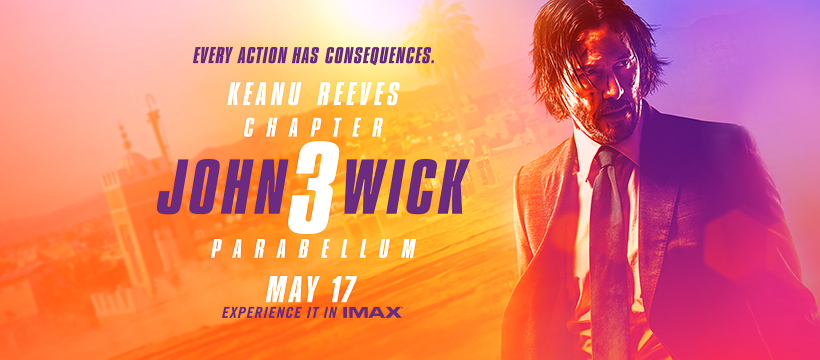
The third instalment of John Wick 3 sees the return of Keanu Reeves as John Wick in a rabid, action packed movie that has, for me, a lot of nostalgic nods to the past 25+ years action movies.
One can see care has been taken care of in the filming and framing of shots and how the camera allows the audience to digest the fight and gun sequences, lessons have clearly been learned from Hong Kong action cinema of the 90s right through to the mistakes made by other “modern” Hollywood movies where shaky cam hides or masks the action.
Whether its a motorcycle scene that pays homage to a similar sequence to the South Korean action-movie, The Villainess; or whether its fight and gun sequences that nod to other movies, John Wick 3 not only knows where it sits against these other movies; but also on whose shoulders it sits upon.
In this third instalment, John Wick is considered “excommunicado” and is now on the run, with nearly every assassin in the game looking to collect the bounty.
In this chase, Wick escapes to Morrocco where he meets Halle Berry’s character, in the hope of being connected to a high table insider who he can bargain his penance back into the society that bore him.
Later, Wick returns to New York only to find the high table have decided to settle debts themselves, and wants to ensure those who break the rules must die; even if its Wick’s “friends”.
In this movie, the action is fast, brutal; but crucially, allows the viewer to see the full gamut of what is going on. Geographically, the place where people and even dogs are within the scene are given great care to ensure the audience is not lost or confused as to what is happening, and where everybody is.
As a chase movie, it allows Wick to try both political and then, war avenues as a means to get what he wants.
Although I must admit; upon reflection – I don’t really understand why he went all the way to Morocco only to come straight back. I’m sure it served some purpose; but it did feel a bit bloated. I’m not even sure what the inclusion of Halle Berry adds to this movie. Its good to see Wick have friends, but for me; Wick is better when he’s alone.
I found the ideas of free will, or duty; and the choices people took in respect of free will vs duty seemed very interesting.
Beyond this, I was very happy to see Mark Dacascos back on the big screen; he’s certainly deserved it. I remember seeing him in Drive and Crying Freeman back in the day. Well done on getting him back to the big screen.
Also I was happy to see a place for the main enemies from the Raid series in this movie; they were a wonderful addition, and again – were great to see on the big screen again.
Finally, with all the training and the effort made in this movie I wonder if the end titles should have ended with a film reel of their training (Jackie Chan style) to give impact to the audience of how much effort was put into the movie.
I’m not sure where else they go with John Wick; in places it seemed to push credulity to the maximum, other times it seemed to try to give Wick too many outs.
Maybe they’ll put Wick in his black suit against snow commandos in the snow, or something equally weird. Regardless, I’m interested in seeing where they will take it.
One only hopes they will convince Chow Yun Fat to come back to action for one last hurrah.
I did enjoy the movie; despite a bit of bloat here and there. I think its a very good action movie and certainly worth watching either as part of the original series or by itself.
At a recent conference, someone asked a host about their business where they sold hair extensions via e-commerce and wanted to know how to improve sales, business and get more customers.
At first, I thought about 4-5 questions, which related to place, promotion, reach, channels…
But then I realised there’s a better question than all of these.
Which is:
What do you sell?
No. Its not hair extensions. Okay, I admit; technically this is true – you are selling hair extensions.
So let’s rephrase the question:
What do you think your customers are buying?
Is it hair extensions?
Okay, lets try another way:
Kodak used to sell cameras, and other hardware; but what should they been selling? Memories.
What does Coca Cola sell? Experience.
What does McDonalds sell? Burgers? Maybe … I’d say convenience.
So – what does a business that hair extensions sell? I’ll give you a clue; its not hair extensions.
Its confidence.
When you reframe / flip the idea of what you are selling means you can now use this to position strategic ideas that might support this idea.
So, let’s carry this forward. How do we sell confidence via Hair extensions?
Blogs/commentary comparing different hair extensions and what people enjoy one type over another.
A video series where hair extensions are compared, and how confident people feel with them
Value-added, complementary services like lipstick, make-up, etc could help support a business that is hair extensions.
The customer experience could tie into this, from purchase to delivery; what does the experience look/feel like when they open the box. What do they do, how do they feel with the hair extensions? Could they post a short video with the hair extensions?
So, instead of selling hair extensions; sell confidence.
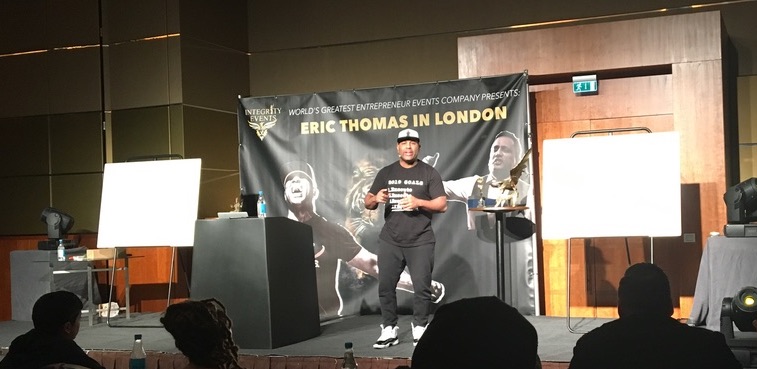
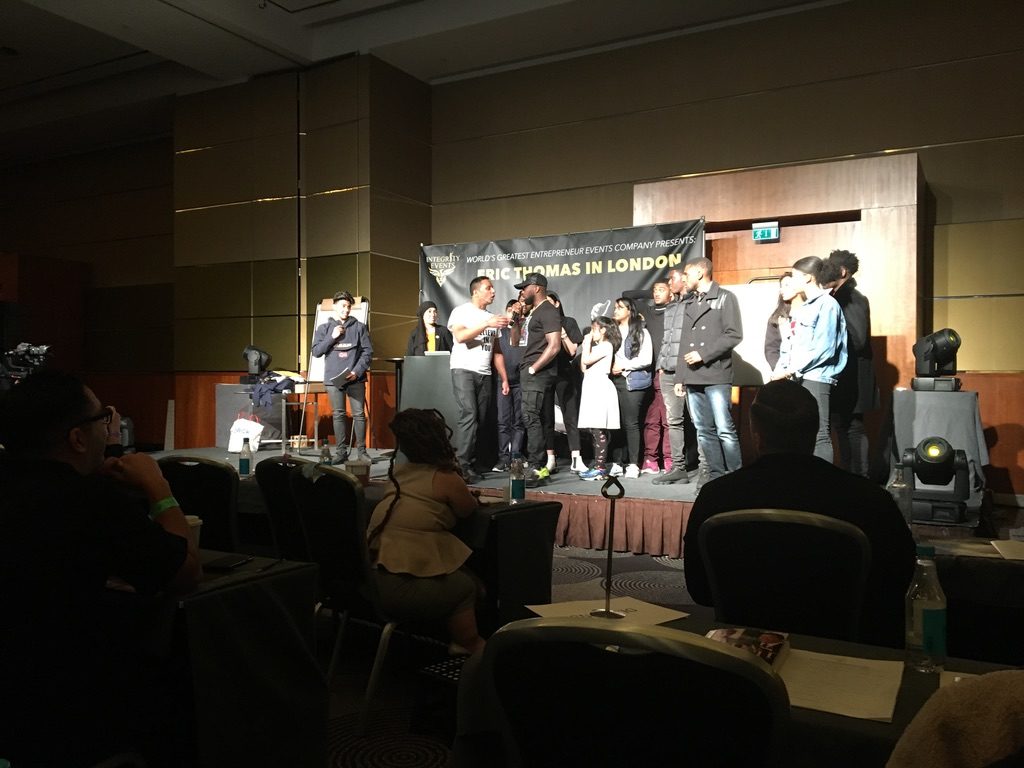
Dr Eric Thomas, US motivational speaker, speaking at Sofitel Heathrow, London (2019)
Ever since I watched Eric Thomas’ most famous Youtube viral hit video, “As bad as you want to breathe” (Vimeo original) I’ve been wondering what it’d be like to be in the same room as him, with his energy, passion, desire and pure motivation causing through your veins to push you beyond fear, or as Thomas states; “At the end of pain is success, get a reward for it”.
Since that original video, posted more than 6-7 years ago, ET’s phenomena has grown exponentially; voicing Nike adverts, doing motivation for sports teams, basketball teams and even recently has range of shoes designed with his words adorning the range of sneakers.
His ability to motivate, inspire millions around the world still carries on; his ventures in the USA have seen him sit with Warren Buffett and other dignitaries. He has, in his own words, “blown up” and is a testament to him and the many people around him.
ET’s venture’s this side of the pond have been far and few between; his corporate speaking price point is very high. His engagements in the UK are very rare, and when he does come, he only ever seems to come to London.
If anyone in ET’s team is reading this; the North would love to see you, I include in that Liverpool, Manchester, Edinburgh, Glasgow, Aberdeen, and yes; even, Newcastle upon Tyne.
So when the opportunity came to go see ET in London on Sat 11 May at Sofitel Heathrow Airport, I, like many others, simply wasn’t sure if he was actually coming. I will cover this further in my critique.
In the end, I bought a ticket and got on 6-hour overnight bus ride to the location; with a return 6-hour journey to hear the great man speak.
I was unsure if I’d ever see ET live, so I decided that a twelve hour journey, a 6-7 hour event, just to see ET was worth it.
A twelve hour journey, a 6-hour event. All to see ET speak.
I arrived at 6AM and was in the lobby and then … ET himself walked straight through the lobby and right past me, he acknowledged me sitting in a chair. But I never got up to say hello. How I now regret that decision!I should have said hi!
Anyway, the event started and I found a seat quite well. Having paid a bit more for the VIP ticket, I was interested to see what it would actually get me; whilst it got me closer to the stage, but I never got to actually say hello to ET, and introduce the idea of coming to Newcastle, to the North had past me by.
The conference suite with approximately 1500 (I didn’t count them) was empty at first and the event was due to start promptly at 10AM — but by 10.10 it was clear something was wrong.
Soon 10.30, 10.45 … now 11AM was creeping up; the event had still not started. People were still coming in at around 11.30.
Perhaps there was simply not enough staff/logistics of being able to handle the processing of so many people?
Whilst this was going on, I had the chance to speak to a few people; I was surprised and delighted to hear and meet so many people who had travelled miles to get here. I talked with two guys who flew all the way from Cyprus to be here. There was two people from Rotterdam, and I believe a lady came from Lebanon, but I might be mistaken.
I always feel at these events, its always good to speak to people; find out how far they had come. I met so many people who have come far and wide to listen to ET.
I met with a guy from Hamburg, great guy. I also chatted with a motivational speaker who was also a firefighter too; wow a great combination.
I got to briefly say hi to some of the other speakers. These speakers were competition winners and runners up from a past event. Although I was unfamiliar with who all the people were, I felt it was important to show them respect and got to chat with a few of them.
I thought the two guys who were sat in front of me were speakers, from their co-branding; but they were premium ticket holders and we got chatting a little. I think they said they were from South London. Later on, they had an issue getting their seats back. I was able to at least direct them to speak to one of the organisers; who promptly got their seats back with minimal fuss. I’m not sure who you were, but it was good to talk to you both.
Eventually the event started, and we got to see the big man himself; ET, heading the stage for the first of two talks he was scheduled for. ET, as usual, killed it. Despite the jet lag, the lack of recuperation; he was able to bring something.
A question from the crowd from someone, “how should we deal with lateness?” – it drew laugher from the crowd, with ET responding with his usual style and finesse.
After ET finished, it was a lunch break; and the second half was due to start soon.
Throughout the show, the main host spoke how he wanted to clean up the industry and was sick of conferences were you were being sold from the second from the moment you were in – until you left; and to underline this, he had decided to bring new, upcoming talent to the stage – a fantastic idea at such an event.
One the younger speakers takes the stage
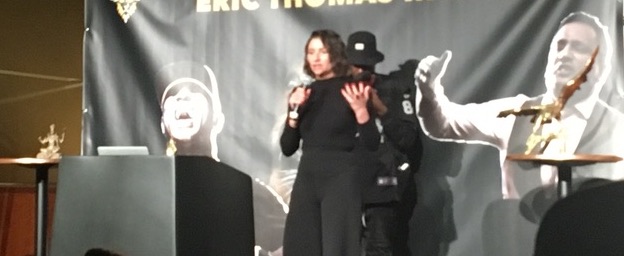
One of the speakers talks about the pain of alcohol addiction, and the rise out of it
It was during this second half we got to listen to a collection of new, upcoming speakers; for the most part they were great.
I however, got the feeling the crowd were becoming increasingly restless in the second half.
The signs were there early on into the conference, and like a wind starting to breeze across a third of the crowd to my left.
As the host went into his own speech, the crowd seemed to get increasingly angry and hostile. The host was losing the crowd. A quick look around and I saw faces of people who were confused as to what the event had turned into. An event about ET, an event that wasn’t about selling; became about selling.
Whether the host knew it at the time or not, the crowd was increasingly getting restless for ET’s second return. I wasn’t joining in; I wasn’t really sure what was causing it.
The host brought up some kids to the stage to talk about success, and a guy joins them and wants to ask the host a question…
A member of the crowd is on stage with younger audience members and is confronting the host to ask a question…
Suddenly the crowd gets incredibly hostile, the host/member of the crowd start arguing and the 1/3 of the crowd to my left are now all on their feet chanting “Let him speak! Let him speak!” whilst some of the the people on my right are disgusted with this crowd; about the lack of respect. And the mini-crowd around the main stage, a scuffle ensued and the event seemed to turn ugly.
The people around me were in shock, we all said in unison “I’ve never seen this thing before! Wow!” I couldn’t believe it. It was crazy! I didn’t know what was going on. It felt like I was watching a car crash in slow motion!
The confusion, anger seemed to go on forever; and then — ET comes back on stage and the crowd are happy — it seemed all they wanted was to see ET.
ET brought calm within seconds, and brought the crowd to a calm. ET brought his charm and answer questions, and even brought the crowd to laugh. Its amazing to see such a talent being able to do that in such circumstances.
ET took many questions during the day; mostly from a strategic perspective. These are my notes from the event:
Have a vision
People will pay you if you can solve problems
Have a goal for the next 30 days, 60 days, 90 days
Be seen as the expert in your chosen field
If you can, dominate the conversation
Don’t just focus on creating content, focus on documenting the journey
Get to the ball first; if shipping arrives in 2-4 weeks, can you deliver in 24-48 hours?
Get/find mentors or someone to push you; or form a master mind group who you meet with regularly.
Prioritise: On work to be done immediately, or later.
Focus: Focus on whats important in a project, and get it done; have that dog to get the project delivered.
Be accountable: Reflect daily, and use goal tracking, accountability partners to keep you on track
Don’t give up, success is on the other side of pain
As ET finished his second speech, to great applause; a majority of the crowd left; even though the event had not ended. All that remained were the first three tables and a few pockets of the audience.
As the show ended, we all made our way; and I noticed a crowd, I assumed they were the premium members with the chance to take a photo with ET himself.
I decided to hang around and see what was going on; perhaps ET would come back out and thank everyone personally — I had a few hours to burn and I thought I’d hang around.
But then … then without warning, an individual in the premium crowd suddenly got hot, aggressive and it was pandemonium. I could hear shouting, confusion — wow, “not again” I thought.
I heard a rumour that the security entourage had cleared the room where ET was, or something occurred where ET had to leave; and this is why the scene got heated. Yet again, another ugly scene marred the event.
I walked back to the train station unpacking the entire day with a colleague I met on the day, we were trying to unpack the event, trying to make heads and tails of the event.
We loved the fact that young people were getting a chance to speak, but lamented the poor planning, logistics; especially in the early morning lead to the issues in the afternoon.
A few of us speculated whether the whole thing had soured relationships between ET and the company, and indeed; one of my fellow colleagues speculated that ET would probably not come back to London.
Whilst I do think these issues can be resolved, I do hope that ET will indeed return to the UK, and not just visit London.
My critiques of the event
(1) The lack of consistent marketing messages about the event.
ET himself cited a Instagram video in which he confirmed his attendance at the London event. He later went on to explain how he doesn’t get involved with corporate marketing events himself and see’s it as doing the work of the company involved.
I’m not sure I can buy this argument. In a world of fake news, e-mail scams, deep fakes, the idea of enabling trust in your customer journey should be your top priority.
If we were to break down the messaging, and using this framework:
Tell me < Most of the marketing messages were placed here
Show me
Ask me
Prove it
Perhaps future events can use this model, as the basis of how to enable trust in a customer journey for an event.
(2) Poor logistics on the day, but the people running the logistics were very helpful and accommodating.
My own experience of the found the people running the event very helpful, nice and accommodating. There was an occasion where two guys could not get their seats back and I helped direct their attention to one of the facilitators and they got back their seats.
However the late start may have underscored the poor logistics of getting so many visitors into the room.
I do not begrudge the organisers for this, I however think a doubling of staff would have helped enormously.
(3) Everyone just wanted to see ET?
I believe at the heart of the issue was that crowd just wanted to see ET. I’m not sure how you can address this an event where its geared around other speakers.
I wonder what could have been done to ensure that people could see and meet ET in a more formalised, safe and comfortable way. I wonder; perhaps you could see him throughout the day in a scheduled window rather than just at the end.
Perhaps scheduled windows of time would have been a better way to allow as many people to see ET.
(4) The crowd/host interaction marred the event
As stated earlier, at least 1/3 of the crowd got hostile/angry. I’ve never seen such scenes before, I’ve never seen a host lose the crowd or explode on an audience before.
Maybe it was the constant referencing to “me and I” in the speeches, maybe it was not reading the crowd, maybe it was the idea of not selling; and then breaking this vow to sell. Or maybe it’s just because the crowd wanted to see ET.
One of the props I’ll give to the organisers was not providing alcohol at the event, this was a smart move; I cannot imagine the consequences if alcohol were mixed with an already hot crowd.
Regardless, the interaction between the crowd and main host soured the event and made us question whether ET would even return to the UK after this incident.
(5) The young speakers were great idea, but they’re talks could have been grouped together and with a fixed-timed delivery.
It takes balls to take to the stage and address 1500+ delegates, even when the crowd is hot; it takes a lot of courage to get on stage.
I enjoyed the talks, though to make more impact; it would have been great to have structured it so that they spoke in set periods, one after the other; for a fixed delivery.
Sadly the structure of when they spoke was sporadic; and some speakers seemed to talk longer than others.
One example of poor structure was putting an act after the main event, whilst this scheduled speaker showed class and was very good; its always very hard to follow a main event, and one only needs to see the lessons learned by WWE and other similar events about how they treat the main event.
Despite this, and some of the audience’s reactions; I thought the idea of bringing new, fresh speakers onto the stage sharing a platform with ET was a great idea and hope other events follow this concept.
“Everyone in the future will have their 15 minutes of fame”
I just want to touch upon a commentary of the trend of Youtube social media/Instagram stars hosting live events; and what it means for us and society in the future.
I just want to touch upon a commentary of the trend of Youtube social media/Instagram stars hosting live events; and what it means for us and society in the future.
I wonder whether this is a hyper-realisation of Andy Warhol’s classic 15-minutes of fame quote; or simply a realisation of the democratisation of fame through the medium of the Internet.
Whether its the boxing match between KSI and Logan Paul, or seeing a make-up artist who made it big through Youtube, or whether its seeing ET, or any other Youtube star. Regardless, this is a trend that I’m sure will continue.
Summary
When I think back of what originally attracted me to Dr Eric Thomas, I think of the viral video As bad as you want to breathe” (Vimeo original), I think of the many Youtube videos he’s posted on his channel; and the power of his motivational speaking to effect, influence and move so many people from around the world.
Seeing him live is a wholly different experience, seeing this larger than life character is something else and wholly different to consuming videos I am so happy that I got to see and listen to him live.
But I must stress; have a goal of why you are attending.
If you’re looking for specific business advise, I wonder if there is a better route; finding a business mentor, finding a marketing expert, or watch Youtube videos that explain marketing on a tactical level. If however, you want to be motivated; then ET is the man to see.
So was the event any good, was it worth it and would I recommend it?
Yes and no. Obviously seeing ET was the main attraction and reason for going; and yes, I still rue my chance of not saying hello to him at 6/7am in the morning when he past me by in the lobby of the hotel; when no-one else was around.
If there is anything I can learn from this event, if you’re the first one at the event, be on the look out for the main speakers; you never know if you will bump into them!
It is a shame that the VIP section didn’t get a chance to meet the guy; but then again, so many people didn’t for one reason or another.
However, the event was soured by poor logistical issues, which I understand because it was their first event; and by a crowd/host interaction which was crazy; it felt like watching a car crash in slow motion. It’s not something I’ve ever seen or witnessed before and soured the event.
And for that reason I am unable, in good conscious, to recommend future events.
I’m sure there will be lessons learned all round, and the next event will be greater, bigger, bolder; but because of this issue, I simply cannot see myself attending new events.
The lessons I learned from seeing ET live, being able to witness how he was able to calm a baying crowd right through to making them laugh within minutes of this ugly-ness has made me respect the guy even more.
Whether there is more value in seeing him live verses simply watching his videos is up to the individual; for some, the value in all the videos is all that is needed; for others, just want to see him, want to say hello and give thanks.
The big question we felt left unanswered was, despite the issues, whether he will he becoming back? Whilst there is an EventBrite page for an appearance in 2020 again, in London; there are question marks for everyone involved.
Despite all of this, I would love to see Eric Thomas back in the UK; but I must emphasise this, the whole of the UK – not just London. A tour of venues that encompass Ireland, Scotland, and especially the North of England.
I wish to extend my thanks to the organisers for bringing Dr Eric Thomas to the UK. I extend my thanks to all the people I met; and wish to thank Eric for coming, I hope despite the issues we will get a chance to see him again in the UK.
Overall rating: 6/10
As a final word, I’ve decided to open this page to comments and thoughts; please keep your comments civil. I will be moderating them and closing the comments in 7 days time.
Paper URL: https://www.researchgate.net/profile/Susan_Jackson14/publication/229100996_The_consequences_of_diversity_in_multidisciplinary_work_teams/links/565f62bf08ae1ef929854906.pdf
Summary
For companies to compete within the global marketplace, multidisciplinary teams are seen as a necessary, and important step to provide structure, bring like-minded people together, to organise and bring together skills, people and abilities and with the sole aim of developing innovative products and services.
Despite this; companies are increasingly finding that multidisciplinary teams do not necessarily produce the desired results; citing unproductive conflict, high turnover of staff, or poor internal communication, office politics, or team members siding with people they usually gravitate towards.
The paper looks at how diversity affects the way team members feel and behave with each other; looking at different challenges such as language barriers, perspective, power, status, and team cohesiveness; and how to address them through organisation, planning and a mix of different actors and stakeholders, such as marketing, suppliers, end-delivery and end-users to fully drive a product to market.
Whilst the popularity of team-based structures reflect the potential to achieve outcomes that could not be achieved by an individual, the payoff of multidisciplinary teams are not always automatic. An organisation should be ready to plan, organise, experiment and reflect upon the current workflow to inform how multidisciplinary teams could improve in the future.
To be effective, multidisciplinary teams must manage the various assets that a team mix brings; such as how they feel about each other, how to manage internal communication issues and expectations of the stakeholders.
Organisations should therefore focus on experimenting, learning upon what is known to date, iterating rapidly and using this knowledge to inform the direction of future team diversity.
The paper states that diversity typically refers to gender, ethnicity, age comparisons, but it also refers to the mix of different stakeholders within the different echelons of the organization hierarchy; in short mixing the junior with senior officials; but it could also mean people in different geographical locations.
However, whilst the benefits of a diverse team include engagement, a sense of ownership, team tenure, and shared values; the paper states that this process should be managed to reduce issues in native language, geography and ensure that design decisions are focused upon the task-relevant knowledge.
Longer-term, this results in increased cohesiveness, satisfaction of self/team, a balance of interpersonal relationships, increased friendships.
Whilst some short-term negatives is that people are uncomfortable, on the whole people find it stimulating, and aids learning.
The consequences of diversity in teams have important consequences, including how individuals feel about oneself, how they process information, how they make and reach decisions; and how they carry out tasks.
Further, diversity also shapes the social dynamics within the the differing members of the team, communication patterns within the team, communications across team boundaries; and teams need to be introduced into organisations as a way to increase learning, team effectiveness, and reinforce cohesiveness.
Success in such teams is lead by organisations electing managers with strong leadership skills, and utilise social science theory to further inform, reflect and improve upon existing frameworks, models and structures to provide long-term, scalable results.
From 1992 to about 1995 I, along with a bunch of my friends at the time, were really into action movies; whether they be the latest Jean Claude Van Damme movie, or Sly Stallone action movie, I always wanted to watch these movies over anything else.
Whether this is the influence of movies like Die Hard (1988) or the Lethal Weapon series is subject to debate, but what can’t be under debate is the cultural influence of Hong Kong action movies of the early 80s to late 90s.
For me, action movies were at their height during the late 80s and early 90s, and one man beyond all others was king of action; Jackie Chan.
To me and my friends, Jackie, Sammo Hung, Jet Li and many others seemed to be leagues ahead of what was coming out of Hollywood at the time.
Of course, we can’t forget the influence of Bruce Lee, and the female contingent such as Moon Lee, Cynthia Rothrock, Michelle Yeoh and so many others.
I can remember watching Jean Claude Van Damme’s Bloodsport or Kickboxer, and whilst I was impressed, I knew that the movies coming out of Hong Kong around this period was far more dynamic, fun and engaging.
I was introduced to Jackie Chan through a relative and from watching some specials around Christmas 1992 when Channel 4 used to show them around 1AM in the morning; I, like many others, was hooked.
Even now, I get a nostalgic feeling watching these movies; even documentary-clip shows like Cinema of Vengeance (1994) or when Jonathan Ross did a behind the scenes look in Son of the Incredibly Strange Film Show (1989) makes me quite nostalgic for a period of time I don’t think we’ll get back again.
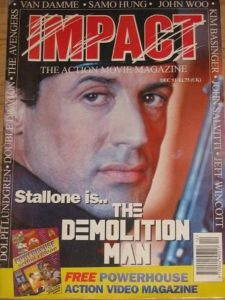
When I first got into Impact! magazines I remember they would reveal a little bit behind the curtain, got exclusive interviews and posters that you wouldn’t get at HMV or any other UK store.
Back when Bey Logan used to be the editor of Impact!, I can recall he used to share so much knowledge and behind the scenes tidbits, I wondered why he never went on BBC’s MasterMind.
Impact Magazine 1995 – Timecop
I made the mistake of getting rid of my copies of Impact Magazine about 10-15 years ago; and I wish I kept them around — I even thought, it’d be a cool series to do a podcast or video series upon.
Maybe if I have the funds to reclaim my old collection and rekindle my memories of a time I really enjoyed.
Interestingly, most of today’s action movies – from super hero movies to movies like The Raid all can trace their lineage back to this period.
I hope some day to do a podcast or interview series on this subject some time soon.
Over the past few years a number of businesses, startups and organisations are increasingly releasing products, services through a subscription method; where patrons would pay a nominal fee for access to services.
Subscriptions, from a business perspective, reflect regular income streams; and may increase branding, fans, etc.
However; one downside is that you never own anything. Mobile subscriptions to digital content services like music, video content may seem fine; but what about other products and services, like cars, houses, and even banking services.
As the question of ownership itself becomes increasingly challenged and questioned by multi-nationals and brands; one wonders if the value that society’s perspective on ownership will be reframed, or; whether consumer power can help balance this relationship between ownership and subscription.
Some time ago I wanted to write an article to retrospectively review my time on the 2018 Multidisciplinary innovation masters at Northumbria University; however I never seemed to have the time. I wanted to give an overview of what the course was about, what did we as students actually do, and give some thoughts for perhaps upcoming students.
What was the course about?
The course is a twelve month masters which is framed through three main modules:
Design-led innovation,
Responsible Innovation Practice,
Strategic Innovation Practice
The course uses applied design thinking and employs service design, lean innovation concepts to tackle wicked problems (and places students in a similar situation as if it you were in a design studio or creative agency.
What does this mean in practice? What do students do?
The course is 80-90% project-led and client facing.
In practice terms this means you are working together as students, either in small groups or in one big team to tackle challenges from clients from a wide range of sectors, including third-sector (voluntary), corporates, small one-man bands, to even more abstract notions of organisational structure.
During this, we often found ourselves looking at creative briefs (or even making our own ones!) and fed the results through a chain of design thinking processes, applying methods, modes of work, etc to address the issues at hand.
Often projects are 2-3 weeks long, often they were much shorter than that. Our final project was approximately 12 weeks long.
How does it compare to an MBA?
I have not done an MBA, but I felt there was a lot of cross-over from an MBA; obviously it’s cheaper – but it doesn’t mean its not as intense.
From my casual reading of MBA courses, this course has elements of team-building, pitching, strategy development, concept creation, and because you’re often working in teams there are elements of emotional intelligence, scoping venture creation (but not necessarily making a venture) and framing opportunities through a business model.
What did I get from the course?
For over a decade I’ve been involved with web/IT or app development in one way or another; and I’ve often been the one who writes the code; and as anyone who has ever worked in that vertical before will tell you – writing code, apps or whatever is a fast-paced environment, working on sprints or fast-turn arounds to get features built and products shipped.
Because of this you’re only exposed to a very narrow field of delivery, as a coder/developer you’re often in “output mode” or “delivery mode”; you are delivering and, rarely, are you asking “why”.
This is what I feel I got the most from this course. It got me to do all the stuff you do before you write a single line of code.
Now naturally, this seems obvious; that’d you’d ask the client lots of why questions – or use systems analysis to understand how a client’s system currently works; and yes, whilst I do agree with you — the best IT companies or self-employed people will indeed ask this question. However, its framed through the lens of delivering a product.
Whereas here, you get not only to ask the “why” questions, but you look at all aspects, and all of the answers are from a transactional point of view.
This idea of looking at issues from needs analysis, transactional and transformative points of view helped me understand not only what goes into a product/service/intervention, but also; why any of this is important at all.
Personally, I thought the course was very good, and closely aligned to what its like to work in a design agency; and also places you in positions where you are uncomfortable and pushes you to address it head-on. The speed of project delivery also lends itself to the usage of Agile practices.
What didn’t the course do?
There is no LEAN, Agile, SCRUM practices explored. Do not expect that by going on this course you will exit with a Prince2 certification, SCRUM certification or a blackbelt in Agile/LEAN methodologies; this is not that type of course.
Also, this is not an IT course; do not expect to be coding anything – but that doesn’t mean you can’t, or shouldn’t. Indeed, I would challenge you to do something different, print a 3d prototype and so forth.
Perhaps, this is my critique. Luckily, I have some background and exposure to SCRUM and agile practices (not all of them, but enough to get things done), but I was left disappointed that we didn’t cover these aspects; and I think its certainly one of the things I’d like to see more of.
Another critique I had at the time I’ve thought about was the course seemed to lack theory, and often found myself comparing it to a software engineering course; where theory is 70-90% of your workload.
But thinking more about it, I realise that this lack of theory delivered as taught is perhaps done on purpose; they only have a year — and it gets you to explore the theory of ideas yourself, in your own time.
Indeed, I often found joy that I could explore ideas and concepts I’ve had for a number of years through books in the library, or spend an hour in the library properly watching and taking notes of a video, rather than wasting this time.
What I’ve found is the course drives you to push yourself; and was a very positive experience for me and am sure should be considered if you’re looking for a role that mixes product, design, innovation.
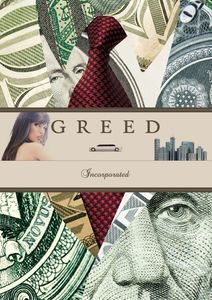
Published by Splotter in 2009, Greed Incorporated sets 3-5 players in the world of high finance and economics as corporate investors or corporate raiders who are, in my words, actively trying crash companies in order to get a big-time severance pay and use this cash to buy fancy executive toys (ie. Private jets, or Premier League football clubs).
Thus, unlike in other economic games, players do not win with the highest cash, but rather; the most victory points!
By most comparisons, the game is very rare, and can easily fetch around the £60 – £150 range on ebay or boardgamegeek; but does it’s rarity and high price really equate to a good game?
Let’s find out…
Played over approximately 10 rounds (dependent on number of players), players will run one, or multiple companies; and try to increase their respective companies cash or actively try to trash a company and walk away with a big-time severance pay.
To do this, players will play 1 card per round; this card will affect the trend and market price for up to 11 different types of goods (ie: Land, Sand, Cotton, etc).
Prices will be adjusted, dependent upon their trending position (ie: -3, or +2).
An example:
Some of the asset cards from Greed Inc
On the example image it shows a few asset cards; and an icon at the bottom shows the change in trends, which in turn will affect the price of the goods.
The main market board in Greed Incorporated
Once players have played a card, players will bid on the asset cards; adding it it to their corporations’ placard. This placard will track up to 4 assets, the people within the company’s structure (ie: CEO, CFO, COO) and 3 piles of cash:
New income,
Last year’s income, and
Free cash
With exception of free cash, a player may not spend or use New income or Last year’s income.
Interestingly, these 3 piles are a mechanic in the game; where if your company did not make more income than last year – somebody will be fired. It doesn’t matter if you broke-even. The only thing that matters is pure profit!
Indeed, it is when you can’t make a profit that someone will take a fall; during this process, a player may walk away from anywhere between 40% to a maximum of 80% of the company’s free cash.
When a company does crash, payouts will occur and a corporate restructure will take place; meaning that a player may lose control of their company and a new owner will be decided.
Planning out who will control a company when it falls can sometimes be an interesting decision: Do you want to remain in control of a poorly run company when it crashes? Or, do you want to offload it so that you can funnel that cash and efforts elsewhere?
Walking away with cash is always tempted. Indeed, a player’s private cash is the only cash that can be used to purchase VP cards (ie: Private jets, etc); and more interestingly, you can only buy 1 VP card per round. So timing your company’s crash becomes important, you can get VP early; or wait to get VP when they get better.
So, after about 10 rounds – whomever has the most VP is the winner of the game.
Components
The component quality is very basic, but gets the job done.
Paper-money, lots of cubes, big-boot markers and a few wooden dollar symbols are all you seem to get.
There are a bunch of cubes which mark all the different 11 goods, and their respective trend (ie: Land could be trending: -3, 0, +1, +2) and are placed on the main game board, as described earlier.
Rule book
Serviceable rule book, seems to explain most actions quite well; be sure to read the Errata.
The rules also includes a grid which is used to calculate the severance pay for players who crashed their companies, split into two columns: 40% and 20%. However, I recommend writing a simple Javascript app that will do all the necessary calculations for you; and display all figures required.
My thoughts of the game, and why I eventually sold it
Having played Greed Incorporated about 5 times, I’m in two minds about the game.
What I enjoyed:
The theme, negotiation gamesmanship are all enjoyable. The speed at which the game moves a long can be quick, or slow; dependent upon deals. There is little AP; as all items are public (except perhaps a player’s private cash); so you know what people can produce and all you have to consider is what deal works for you and your multiple companies.
“Growth! Growth! Holy growth!”
I really liked the mechanic / narrative that your company must always make a profit, a not simply good enough to break even, you got to beat last year’s expectations!
I even liked how it didn’t even matter if your company has got over a billion in your free cash; shareholders are only happy if this quarter if you beat expectations.
Bill Maher highlighted the idea of “growth at any cost” in a 2016 video, which I think neatly reflects this narrative.
“In corporate America, the stock market is the tail that wags the dog — growth! growth! holy growth is the only thing that ever matters. Better than last quarter! Beat expectations! Eat more hamburgers!”
url: https://youtu.be/y4X3OSd6HzY?t=209
I also enjoyed the 18XX style trading mechanic, where you could run up to a maximum of 3 companies and then trade between the companies (ie: Buy Land for $1, then Buy it back again for $100).
What I did not enjoy
The game is incredibly linear. The story, narrative, flow of the game is always the same. It has only really got 1 main gimmick, and once you’ve seen it; there is very little reason to play the game.
Despite the idea that you are trying intentionally to crash companies, there never seems to be enough time to do this; and the number of new companies to establish is strictly limited. This means players need to balance building an engine verses building points, and rarely do you get options to do either.
There is this notion within the game that speaks to “we want you to crash companies” but then on the other side give you limited tools to accomplish this goal.
Further, for novice players its very easy to eliminate yourself if you crash your only company and have not enough cash to buy a new company and have to wait around to establish a new one.
Pros:
Strong theme with strong economic and financial ties.
Can play fast/quick; but is dependent upon player’s time for deal-making.
The game feels like it has something to say about its theme
Cons:
The game is pretty rubbish at 3 players; you NEED to play it with all five players, the more actors mean more opportunities for deals.
Feels like there is not enough time to build your engine
The game setup is always the same, and other than the variation of the position of the numbered cards within the brackets (10-20, 20-30), there is no modular setup.
The game’s narrative is always the same. Prices go up, eventually they fall.
I feel there are better games about acquisition out there. Acquire is better, some of the lighter 18XX games are better.
Is it worth buying?
Only if your a collector. It certainly (as of time of writing) holds its value.
Only if you want to complete your Splotter collection
Only if you like economic games with negotiation
Is it worth playing?
Yes.
Play the game. Its worth it, just to understand the flow of money in the game and what the game’s storyline is.
Overall thoughts
I enjoyed the game, I did like its narrative and trading and negotiation elements. What I didn’t like is how every game felt the same and the decisions you made, the story flow of the game was very linear. But I guess it has to be that way for the game to weave the story it’s trying to tell.
Bottom line: Play the game. I just am not sure if its worth buying it, unless you are a collector or need to squash the bug that wants to know if the hype lives up to the delivery.
I read the book in about 1 day, its a pretty worthless book. It has very little to do with the Psychology of Selling at all.
–
I was very excited by the chance to read “Psychology of Selling” through my local library, and I was very excited to read it given Tracy’s background and name recognition in the industry.
However, having completed the book in practically one day, I felt the book was incredibly lacklustre. The book was more about self improvement, a self-help book dressed up as a sales book.
It wasn’t even about psychology (where are maslow’s famous hierarchy of needs?), or even sales. Its not even pop-psychology and I would definitely not recommend it as either a sales book, or a self-help sales book. There are better books on the market.
When you compare “Psychology of Selling” to “Spin Selling” by Neil Rackman (An actual Psychologist of 25 years experience), you’ll agree that its night and day in comparison. Rackman methodology goes through different ideas, methods and techniques and explains them; whereas Tracy gives a passing reference to an idea, dresses it in so much new age self improvement jargon that you may even forgot this book was meant to be about Psychology of Selling, not Psychology of self improvement.
Yes, Tracy does cover the 80/20 rule, covering that through prospecting, building rapport, doing a thorough needs analysis of your product/service and the customer’s needs can help identify and turn prospects into winning sales.
Further, Tracy states to set goals, daily, weekly, monthly sales; stay on target, achieve your goals, use vision boards, plan your calls ahead, and look at the reasons why people might buy your product (is it out of fear, greed, prestige, etc); but the problem is Tracy doesn’t give you actionable items to do, except to set goals.
Whereas Tracy argues that the best time to make a sale is right after a sale, and that prospecting via the phone is not a luxury, but a necessity; he seems to categorize the customer as somebody to be sold to; and forgets something that Rackman and others (including New Rules of Marketing author David Meerman Scott) in his book “SPIN selling” readily identified some years ago, and that is — the customer has changed, and the old ways of selling are dead.
Customers are sophisticated, and the way business target, market and reach them have changed; so has the way business sell to them. The image characterised by Tracy as a Business person whom is trusted, is dressed for success and uses buzzwords mis-judges the customer. As many authors have noted, some customer-business relationships demand trusted partners, and the journey of a customer should be explored.
As a final note, I want to state that I felt that this book really missed a lot, it felt like another self-help sales book, there was very little useful in this book and would not recommend it to anyone serious in getting into sales at all and would recommend SPIN selling, New rules of marketing and PR and other more seasoned, tactic-based sales books on the market.


 A very poorly written book about sales.