Author: Amo

  • Review – The Shadows Edge (2025)

    Jackie’s best for the past decade, but don’t expect it to be like it was in the 80s

    There’s uniformity amongst most Jackie Chan fans, that his past decade of work has been pretty poor, with small exceptions here and there. The Foreigner (2017) was a tone shift in his work, and was definitely a step up from his CGI lions, tigers, bears, or de-aging nonsense that he seemed to be playing with in a way to keep up with Hollywood spectacle.

    In some ways it felt like the past ten or so years, there was no vision of what a JC film should be like, what is his role in his later years. He’s hitting hits 70s and still doing heavy lifting in the action, but it felt disconnected to the stage in his career.

    Yet, we still expect him to be the Jackie Chan of the 80s or early 90s, fighting off hundreds of people with long intricate fights with slapstick comedy thrown in. He’s not doing that kind of action any more.

    The Shadow’s Edge (2025), does it right, it puts JC as a mentor, behind the scenes and pulls him when he’s needed. Not only that, his counterpart, Tony Leung Ka-Fai, is really good in his role and their respective stories mirror each other, especially when it comes to their relationships with their family.

    I didn’t see a single review or trailer before The Shadow’s Edge(2025). When I heard that they were going to show it in selected cinemas, I jumped at the chance to see the film. It’s not every day you get to see such movies on the big screen here in the UK, and even rarer that it was shown outside of London — so I want to thank whoever it was who decided to give it a limited cinema release, and for making it available outside of London.

    I was very surprised by this movie. It’s not a standard JC fan. Do not expect Armour of God, or Drunken Master or Police Story I-III. If anything, it’s a much darker movie, with few comedy scenes. It plays it straight, and it works. It has a lot more emotion and more focus on the story and characters. It seems to borrow ideas from “New Police Story” where there’s a group of young criminals and Chan must try and bring them down, and there are subtle slight nods to “God of Gamblers”, “Police Story” and other movies.

    The fight scenes are all close combat, and reminded me of one of the Marvel movies (probably Winter Solider). I think this works in this movie because the hero and the angonist are fighting scrappy, it’s close combat. Tony Leung Ka-Fai and Chan do fight, and its close quarters, and very well done. But do not expect long drawn fight sequences and sometimes the clarity isn’t there.

    I thought the supporting cast did very well, especially Zifeng Zhang. I was also very surprised to see Melvin Wong as a, I guess, super intendent, although he seems to disappear in the last part of the movie; it would have been nice to have seen him near the end.

    I read some quick reviews that this is actually a remake of two other movies, Eye in the Sky (2007) starring Simon Yam and Cold Eyes (2013). I must say, I’ve never seen these movies — so I’m not sure how close they are. Looking at the synopsis and trailers, there seems to be a lot carried over.

    The movie also looks at how AI and police work might (or does) work, with instant tracking, near-instant feedback, there’s a big-brother esque to it, at times it felt like “this is probably what Palantir, Oracle’s”.

    With all the AI, biometric and super advanced computerised tracking they used, I wonder how there could be any crime at all, perhaps this is a paradox?

    The movie is good. It’s certainly Jackie’s best for a decade. It’s the kind of movie I think suits him, sort of in the background, acting as a mentor figure to plucky newcomers to the scene, throw in a few close combat fight sequences and weave a story that mirrors both the agonist and hero of the film.

    Whether there’s a sequel (they seemed to leave a lot of bait to say there would be), will be interesting to see.

    It’s worth watching, and I am grateful I got the chance to see it.

    7/10.
  • The reason why 80’s HK action cinema works so much better than Hollywood action

    Stallone, Schwarznegger, Van Damme, Norris were the four cornerstones of 80’s action cinema. Where some dominated the cinemas, others dominated VHS and home cinema.

    At the same time, half way across the world, in Hong Kong, action cinema had a massive boom period; from 1980 to mid 90s. This is widely considered the peak of the Hong Kong action cinema boom.

    The HK action cinema scene was different, it was faster, flashier and more dynamic. Whereas Hollywood beat HK cinema on almost every vertical; on action set pieces, on spectacle, on budget, on muscles and on star power; for me, it didn’t have the same style or visual.

    So what were the differences?

    1. Pacing and Rhythm

    I think cannot emphasise rhythm, it’s central to almost every HK action movie. The pace is also faster, much sharper, with a rhythm that matched the physicality of the performers.

    2. Framing

    Framing was absolutely key. Directors like Lau Kar-leung, Jackie Chan, and Sammo Hung choreographed with the frame in mind – action was designed to play within the frame of the camera.

    Action sequences made sense, things in the background were important. If you saw a staircase or glass window in the background, a sequence would lead to that.

    Whereas, in Hollywood there would be lots of quick cuts, generally, you couldn’t follow the action (except in big action set pieces).

    3. Choreography

    Action was performed by skilled martial artists, many of the actors came from an opera or kung fu background.

    Choreography was intricate, physical, and felt dangerous; sometimes they were!

    Precision and timing were everything.

    4. Poetry

    I think this is more for the John Woo movies, which focused on heroic bloodshed, slow motion, operatic gunplay. Whilst I didn’t enjoy all of Woo’s movies, the style was unique enough to differentiate it from Hollywood action that used gunplay as a means of destructive force.

    Whether you liked HK cinema or preferred Hollywood action, there was something for everyone.

  • 3 simple retrospective exercises for small businesses

    Whether you’re running a fast-paced start-up, delivering a high-stakes presentation or workshop, or running a small micro-business, regular retrospectives may help to correct your course.

    When I worked at creative, tech and digital agencies we regularly ran retrospectives to see where we are, and what we needed to do to course correct.

    Think of retrospectives as a “performance review” for processes.

    After a project, workshop, meeting it helps you ask:

    • What worked?
    • What didn’t?
    • What needs to change next time?

    Here are 3 retrospective frameworks I’ve seen work in small teams.

    Pick one. Try it out. Or, make your own!

    1. Start, Stop, Continue
      Ask:
    • What should we ‘start’ doing?
    • What should we ‘stop’ doing?
    • What’s working, that we can ‘continue’ to do?
    1. Working, Not working, Do, Measure.
      Ask:
    • What’s working?
    • What’s not working?
    • What do we do about it?
    • How do we measure success?

    My tip: Try adding another column “Who is responsible for”, and assign tasks.

    1. Ship retrospective
      I’ve used this the most, and is my favourite tool. It asks 4 questions:
    • Wind: What’s pushing us forward?
    • Anchor: What’s slowing us down?
    • Rocks: What’s coming up that might be a risk, or threat
    • Island: What’s the goal? / What is the treasure?

    Another one you could add is ‘Sun’: What are you excited about (looking forward to)?


    Q: How do I use these?

    Pick a retrospective, invite your team for half an hour (or more if you need it) to share and bucket reflections about a project, workshop, etc.

    It’s important you allow the participants to post reflections on a shared board, and do it silently, without editing them, and without hovering over people.

    Review them in a group. Co-own the journey.


    Q: How often should you do this?

    This really depends on the project. Perhaps you can do it every Friday, or if it’s critical, maybe even every day.

    From my own practice, I ran a quick retrospective after every workshop with other facilitators.

    Try it out for a month. Review it. If it doesn’t work then try something else, or even abandon it and do something that is a better fit for you / your team.


    Q: How do I know it’s working?
    If nothing is changing, or no-one cares, then all the retrospectives in the world won’t matter; it’s just theatre.

    Do a sense check. Is this working? If not, why not? What should you try/do instead?


    Remember that retrospective exercises above are NOT about blaming people, or finger-pointing; about improving processes.


  • Review: Enter the Dragon (1973)

    There’s no doubt that Bruce Lee’s Enter the Dragon (1973) is a cultural movie, and for many kickstarted the whole Karate/Kung-fu movie genre. You could even argue it launched the whole Bruceploitation, and even inspired parodies like Kentucky Fried Movie (1977), Shaolin Soccer (2001), Balls of Fury (2007), Black Dynamite (2009), and even video games like the original Mortal Kombat, and many, many more.

    The movie had it all, the charismatic Lee, the iconic music and is still, even after 50 odd years, quotable, memorable and watchable.

    Enter the Dragon is Bruce Lee’s biggest American movie, and permanently entered Bruce Lee onto the world stage, and is Lee’s final film to feature his direct involvement (later movies would edit, loop sequences from other movies to fake his presence on screen).

    The movie is Bruce Lee in front of, and behind the camera; it’s a much a flavour of his martial arts Jeet Kune Do philosophy as it is about Lee’s viewpoints on how to film, do action.

    Outside of it’s undoubted inspiration to millions around the world, the movie is about Lee essentially playing a spy trying to take down an evil mastermind who resides on an island where he can’t use guns, and must resort to his own martial arts skills to survive.

    Along the way, Lee’s meets John Saxon and Jim Kelly; both bring a sense of unity and friendship.

    The movie plays very much like a James Bond movie; and is arguably a remake of Doctor No – with a lot more fighting.

    I’d also like to share some critiques I’ve thought the movie.

    “The Chinese Superman”

    Lee in this movie rarely gets hit, and when he does; it’s a plot point — an example of this is when Lee gets hit to let the evil mastermind, Mr Han, to escape to his hidden bunker.

    Lee always presses forward, and he never fights on his backfoot. Although Lee acknowledges himself getting cut, it seems to do nothing, he’s never under pressure, or doesn’t seem to fear much.

    There’s a lot of reasons why this might be. My own thought is that during this time Chinese were never seen in this way before.

    “The fights are inconsistent”

    Lee’s standard is very high and is hard to match. Whereas Lee’s fights were very high quality (for that time), supporting characters lacked the same sharpness. The inconsistency, quality of fight sequences took a piece away from the movie — but that’s probably because Lee set the standard, and its hard to match.

    “It should have been Jim Kelly at the end, back to back with Lee”

    It’s easy to say now, perhaps at the time it was hard to see the charisma that Jim Kelly brought to the role, and how cool it would have been if it was Kelly standing back to back with Lee at the end of the movie, fighting together. Sadly, it never happened.

    Summary

    Enter the Dragon is a success, iconic, memorable, quotable, cultural, and launched Bruce Lee and martial art movies to the world; for this, it will remain an important, integral movie to martial art movie watchers.

    Overall: 7/10

    If you’re interested – there’s a great documentary by Bey Logan on Youtube on Enter the Dragon Hong Kong Locations (Youtube) which covers a lot of history, locations and background of the movie.

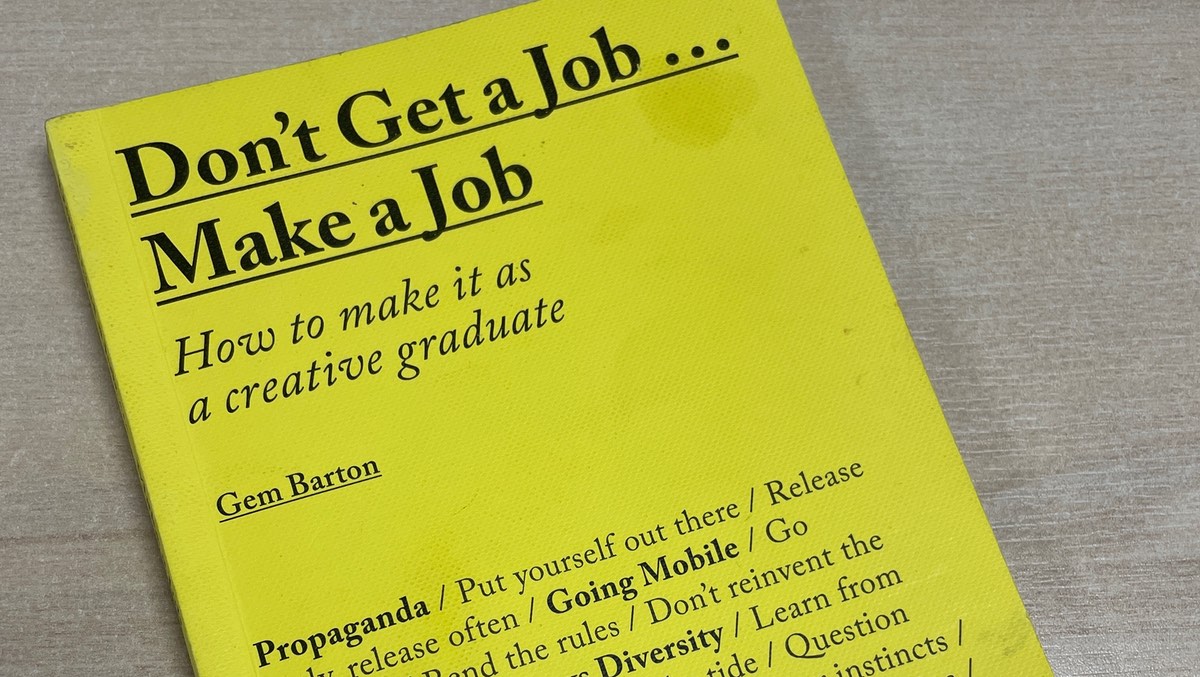
  • Review: Don’t get a job, make a job

    Review: Don’t get a job, make a job

    Editor note: This book review has an Amazon affiliate link. The author was not paid or sponsored for this review. This is the first edition from 2016.

    One of the perks of being an alumni member of Northumbria University is being a member of its library. It’s got a really good collection of up-to-date and classic business, management, marketing books out of all 3 North East Universities I’ve been to.

    It might seem strange in today’s world of digital-first libraries, and AI-bots that can summarise 10K books and give you the bottom line summaries in less than 10 seconds that I sometimes prefer sitting down with a physical book.

    Aimed at creative graduates leaving University, “Don’t get a job…” written by Gem Barton is a careers book that asks the reader to consider self employment.

    It uses stories from other creatives from around the world, each with a different lens, story of how they got where they are, and what their advice is.

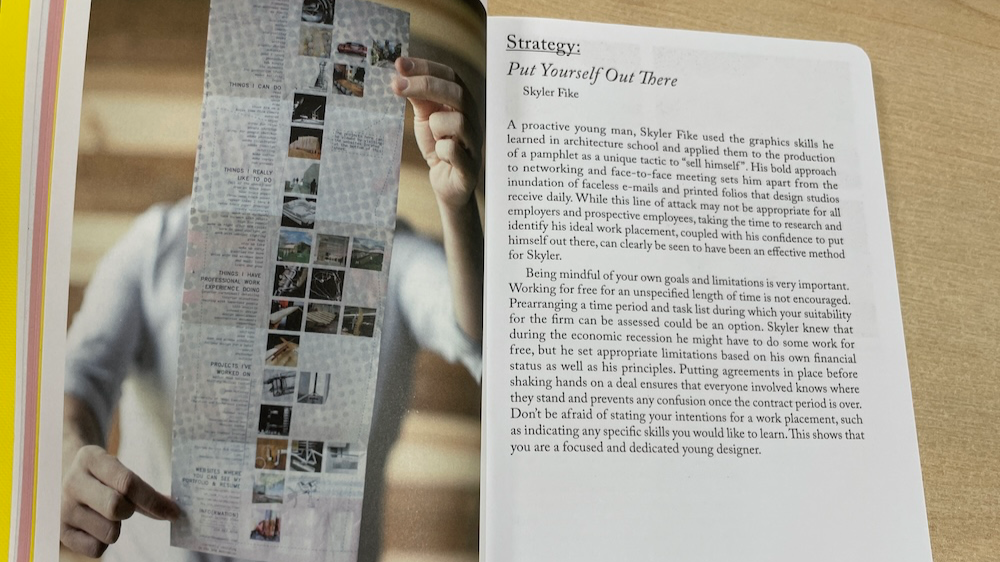
    Strategy - Put yourself out there
    Excerpt – Put yourself out there

    The book is highly visual, with excellent typographic, graphical layout choices, with very inspirational stories of other creatives that are trying different ways to make their own career, forge their own path. Each story is personal, ambitious, hungry and has a viewpoint.

    What I really like about this book is the visuals, it connects the story with the creative; sometimes it makes me wonder how to up my own game on how to present creative work.

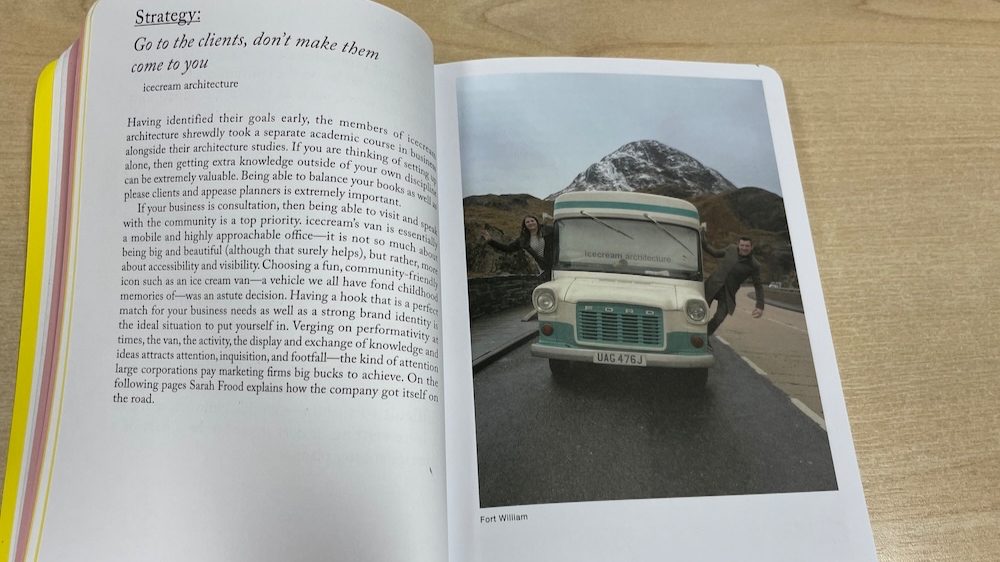
    Go to the clients, don't make them come to you
    Excerpt – Go to the clients, don’t make them come to you

    Each section includes stories or case studies from real-world creatives, how they got to where they are, their successes—and mistakes.

    What I also find interesting is that book isn’t about creatives sitting in an office with laptops, and I didn’t see any unobtainable silly stories of sitting on a beach or working 2-3 hours a day; instead, there are more useful and interesting – such as the above picture where they got out of the building, use creative guerrilla marketing methods; and this isn’t just a one-off, there are other stories within the book that are similar to this.

    The main contents are about self‑promotion (or propaganda), going mobile (go to clients, and don’t wait for them to come to you), specialising in one niche verses lots of skills, trusting your gut (on projects, clients), collaboration verses going solo, and gusto (work with passion, brand, momentum).

    On the downside, the book does focus quite a lot on 2008 and in the economic downturn of 2012; and obviously the book was written pre-the current AI boom or in the post-pandemic world. The stories, interviews and viewpoints from studios are a bit unstructured too; sometimes the story will talk about 2-3 different viewpoints in one story.

    Although I did enjoy the book, there are 3 parts I wish the book had explored more of:

    • Money and bootstrapping. A lot of the examples seem to be from people who seemed to have had money to invest in their business. I’d like to have seen some examples of those who bootstrapped their way up. Not everyone can afford vans, big print, marketing runs, etc.
    • Business development (Biz Dev): Getting leads, Winning work, Doing proposals, Getting paid. It doesn’t need to be templates, but stories on what these creatives did to get the lead (or where to fish), win the work, how they deal with work-on-spec, whether they do or don’t do proposals, what do board room meetings look like, and what do creatives need to think, do, say in meetings that the c-suite want?
    • Portfolios. I got a lot of inspiration from the visuals, but there is very little on what to put into a portfolio; or what clients expect from portfolios or pitch decks.

    My top take-aways from this book

    • Don’t wait for a job—create one by designing opportunities around your own strengths, ideas, passions and values.
    • Build your personal brand— I think today, as everything seems to be about personal brand, how you present yourself matters more than just academic pieces of paper.
    • Experiment —do rather than overthink; real progress comes from action, trying things.
    • Collaborate—who can you work with?
    • Document your work, wins and losses—this adds to your personal brand, but you can also repurpose this in different channels.

    Highly visual, good typography, excellent layout, good encouraging inspirational stories, but lacks practical and actionable advice.

    Whilst it isn’t a business book, I would recommend reading this (or the more up-to-date version) for upcoming design and creative graduates who are unsure of what their next path is.

    Overall, I’d rate this book 3/5

    Links:

  • What’s wrong with this traffic light?

    “You need to complete this …” said the manager, pointing to a hyperlink.

    “What is it?” I asked.

    “You need to track your happiness every day on this app”, the manager replied

    I got a bit perturbed. I just joined, and this was part of the on-boarding.

    I wasn’t expecting this at all.

    “Why?”, I replied.

    “Oh it tracks your happiness, some people do it later on in the week, you need to be sure you’re on it, and get it completed before the end of the week. Don’t worry it’s anonymous”

    I didn’t understand. Also, I didn’t believe them when they said it was anonymous.

    Why was I being asked to track my happiness?

    Why the urge/need to have it completed before the end of the week?

    Was their an implied threat?

    Was the manager saying if I didn’t I’d get pulled for it?

    Why did I need to manage my happiness?

    It felt so strange and out of place.

    I took a look at the website, and on it was a traffic light. You had to click Red, Orange, Green to signify your “happiness”.

    I got really suspicious about it.

    What if I press red. What if I pressed it every day?

    Was someone watching? Was someone going to call me into their office?

    Who is sitting there measuring happiness like this?

    Why didn’t they trust me?

    I really felt that the company was trying to find any way to find anyone who didn’t fit their mould.

    I must have sat and stared at this traffic light for a good ten, twenty minutes.

    “I better press green, I guess”. Worried that the manager might wonder why it’s taking me so long.

    I’ve been around the block enough times to know that this is just games, games to see if you fit in, to see if you’re the type to make a fuss.

    I looked around the room, fully adorned with value’s in big chunky letters.

    “Creative, Fun, Challenging” (those weren’t the words, but close enough)

    I suddenly felt that these words didn’t gel with what I was looking at.

    I took another look at this traffic light system

    There was something bothering me about it.

    Why didn’t their values relate to this silly traffic light system?

    Why on earth was this silly traffic light website app bothering me so much … why not simply click “green” and be done with it and get on with my work?

    Then it hit me. I figured it out.

    Let me see if you can work it out.

    Tell me. What does green do? It tells me that everything is ok

    Cool. What about orange? What does orange do? That everything is kind of ok?

    Fine. What about red? What does red do? That something is bad, wrong, pain, frustration, anger.

    Great.

    When would orange matter to the company? I would say sometimes it would check it, but largely I would say that it doesn’t matter.

    When would green matter to the company? I think they’d probably report on high numbers, but I would say that would largely ignore it. It has some value.

    Ok, so when does red matter to the company? I would say almost 80-90% it matters.

    Therefore, I would suggest you don’t need orange. It tells you nothing.

    Therefore, you probably don’t need green.

    You only care about when it’s red. That’s when you act.

    I started to smile. I couldn’t believe they had missed this.

    It made me wonder, when was the last time they had a meeting because everything was green, or orange. My feeling was they never did. They only ever did it when it was red.

    I wondered, did nobody else in the company not see this?

    Also, a traffic light system is like the worst way to measure happiness. There’s only 3 choices, and happiness isn’t binary, it’s a spectrum — and even if you could qualify it as a number, it’s not contextual.

    Also, wouldn’t such a system just compel users to press green. They’re not going to tell you their real feelings, why would they?

    The company doesn’t want happy workers, it wants productive, effective workers. It wants to protect its own survival – both from external and internal threats.

    My feeling is that a traffic light system is a terrible system to measure happiness, but I would also ask — why do you need to measure happiness at all? Wouldn’t people just say they are happy when they really aren’t?

    It creates its own paradox. People will just press green to get on with their job, and the metric suddenly loses all value, but to upper management they’ll be smiling ear to ear, and reporting PR metrics that state the company is 88-90% happy, when in reality everybody knows its meaningless.

    So I wonder, and I question the efficacy, and requirement.

    Measuring morale is hard. Most morale surveys are just bunk. Managers will always fudge them to make them look good to upper management, employees will game them because they don’t want to be caught out, or feel like they aren’t part of the crowd or in fear of losing their job.

    Either people, like me, feel its a way of catching people out, to make them conform; or people just ignore it and just press green to get on with their life; or they value it.

    I wouldn’t know what the best method is. But here are some ideas.

    “I quit” – watch the amount of people who leave voluntarily. If your big names are quitting, there’s probably a reason.

    Anonymous exit interviews – if you’re company isn’t doing exit interviews, you’re not learning anything. I would see if you can implement exit interviews, perhaps its through another company so that the person can freely express opinions without fear of some kind of blow back.

    The CEO should listen, and managers should not be looking out for “bad apples”. Imagine, you could sit with the CEO and not managers. The CEO should ask “If you were me, and you were to change anything – what would it be?” and just listen

    Watch who sits with who? Is your employee sitting alone at lunch, are people talking behind people’s back, are there people gossiping, or saying stuff with sarcasm.

    I’m not some management guru, I don’t have all the answers – but here’s what I learnt from this, if you need to measure morale; you won’t get it from traffic lights, you’ll get it from observation, but talking, by listening and by acting, and reviewing it.

  • Start small. Bootstrap it. Build it. Test. Repeat. That’s it.

    I don’t care how many Youtube videos, Reddit forums or Facebook ad’s you’ve seen that claim a 7-figure, 9-figure business that can be done in 30 seconds without you thinking.

    You are not them. You are not Hormozi, or Cardone or anyone else who might be the big name today.

    They all had money before they hit the mainstream.

    They have a team, its hidden away – they like to promote themselves as one-man bands, as playing the beach lifestyle — it doesn’t exist. And neither do the claims of 9-figure incomes.

    The reality is this. Business is hard.

    If it needs to be repeated, then I will repeat it.

    • Start your idea and break it into small chunks.
    • Whats the smallest thing you can make, try today that might work
    • Can you put away 1 hour a day or a week on developing your idea, from concept to business model, to prototypes, to shipping, to collecting revenue?
    • Set a budget of what you’re willing to spend. Ask, can you do it on zero — Bootstrap everything!
    • Try small pieces. Try the smallest thing you can do to see if it works.
    • What do you need to learn? Is it coding, is it marketing? What if you started with the idea that you don’t need to know everything? What if you just need to get moving, get the idea out there, try it out
    • Just because you shipped it, doesn’t mean people will use it. And that doesn’t mean people will pay for it. And even if they do, doesn’t mean they will continue to pay for it.

    I hope this helps

  • Thoughts from the TechNext Sustainability hub

    “We need to move from talking shops, to doing shops”

    On 17 June 2025, TechNext held the Sustainability hub event at the Energy Central in Blyth, Northumberland I saw this model of a ship showing how coal transported by wagons from local mines dropped coal into awaiting ships via wooden staithes was a reminder of the region’s long history of shipping coal around the world, and forming the backbone of the Industrial era.

    The region’s move from coal, to wind, heat and other renewables was the focus of this Sustainability event with multiple talks and discussions around three main reoccurring topics or themes:

    • A state of play: What it is, where we are, where we are going
    • Discussions of ambition, vision, growth
    • What it all means for locals, businesses and the region

    Who benefits?

    A lot of the discussion focused on what big ambitions are in play, who the big players they (investors) want to attract; but I wondered — where is the local business owner or soloprenuer or artisans, or wood-workers, metal workers or upcoming small startup software developers in this journey? Do they get to be part of this?

    I was struck by a presentation showing how to qualify for grants immediately ruled out any business who didn’t have 1M turnover, or a headcount over 20/25, or hadn’t been in businesses for more than 2-3 years. I wondered, who is this talking to? It certainly doesn’t sound like it’s talking to this region, or even Blyth, a town that has had economic decline for years, if not decades?

    How do we get the cash? And when do the invoices get cut?

    Charlie Hoult, a local entreprenuer, and one other person raised this far more succinctly than I did in my notebook; they wanted to know – “where is the cash, how does a local business owner or entrepreneur get this cash, the grants and when do invoices get cut?”

    I think this discussion underscored a few points and questions, such as:

    • Who gets to invited to eat at the table?
    • Where are the deals? Where are opportunities? Where might we find them?
    • How might we translate real business challenges that offshore renewables have to companies, businesses in other sectors that might not clearly understand what these challenges are?
    • How do local businesses get involved?
    • Are deals being cut with companies investing in the region (ie: manufacturing, supply chain, offshore and renewables) to ensure that supply chains must source locally first? And if not, how does a local business owner benefit in this investment?
    • What efforts are being made to reduce barriers to entry? Reduced paperwork? Nobody likes filling in forms, especially endless tender applications that take weeks, months when the business world is increasingly faster and faster.

    Okay, so now on to my critiques of the event.

    Jam tomorrow

    I felt a lot of the discussions were jam tomorrow. Projects yet to be realised, money yet to be finalised, a lot of growth ambitions. Talks of skills shortages with schools and educational pipelines that won’t be filled for 5,8,10 years.

    Presentations need to be shorter, and get to the point

    I’m going to be blunt here. I felt there were too many presentations that never got to the point, or had any call to action; or felt like academic lectures.

    Please – speakers, review your presentation and ask hard questions of your deck — “who is this presentation for?”, “What is the call to action; what am I asking the audience to do about it”? “What is the urgency”? “How do I get involved?”, etc. And … can I reduce the number of bullet points (ideally zero!)?

    3 Suggestions

    I thought I’d finish on 3 specific ideas on how to make these events more valuable.

    • Connections wall – I didn’t know who was attending, what their challenges were, or what help they can offer. So, my suggestion is simple. Have a wall at the event that says (We do X, We need Y). It can be physical, tactile (on the day).
    • Labels for what the person is there for. A simple way to identify who is there for information, networking, deal-making, or just attending.
    • Have more ‘doing’ shops and talking shops — A mini workshop or design sprint – I like activities over talking. We had 1 workshop on heat networks, which was fun; I’d like to see more of these. I’m aware not everybody likes workshops (they can feel like homework). I’m also interested in what does legacy ideas look like from these events?

    My take-aways

    My 3 take-aways from this event are categorised into 3 buckets:

    • Dealflow – Where are the deals, what are the opportunities, challenges that the offshore renewable industry has, how might we (locals, solo-prenuers and big business) get involved, what does this dealflow look like, how might we reduce barriers, shake more hands, and get deals done, quicker and faster?
    • Ideaflow – Where are the ideas? How are they being captured? How might startups, business owners, students, locals, unemployed, and all those in between get involved? what does idea legacy and agency look like? Who owns and champions these ideas?
    • Actionflow – Speed. How might we move faster, a sense of urgency in not just our talks, but in our actions, in our deals – how might we talk today, and get deals done tomorrow? What does speed look like for the North East? Can we balance “move fast, break things” with sober, reflective, long-term chess moves that sustainability deserves?

    Let’s start a discussion – what take-aways did you get from this event, and how might events like this be framed, to make them more valuable to you?

  • Design and De-risking

    De-risking is part of good design.

    De-risk all the things (or as much as you can).

    That was my 2 main takeaways from today’s #TyneDesignWeek event “Design in Software Delivery – A Decade in Retrospective” by hedgehog lab.

    Ray Clarke and his team broke down how hedgehog lab approaches design strategy, design impact and business performance for their enterprise clients through 3 lens’

    (1) Performance

    (2) Delivery Model

    (3) ROI

    They discussed how they moved from producing apps to order, the challenges of un-scoped projects, through to a more consultative approach through stages of (1) Discover (2) Design (3) Build (4) Scale.

    Ray and his team qualified de-risking as understanding the why; why does this project need to exist, and what is the problem to be solved, what are the outcomes, what research must we do, what are the expectations, and what is the most impactful or valuable thing to be built?

    Questions from the audience ranged from how to manage client expectations, relationship building, to what does the pre-sales process look like and how is design being sold to decision makers, what the internal process, methodologies look like, and turn around times.

    I’d like to have dug deeper into the pre-sales stage, but overall I thought the event was a very good overview of what design impact, design strategy can look like at the deal-stage, delivery stage and exit stage.

    As a suggestion, I’d like to see a “North East Design Agency Leadership” round-table for upcoming agencies to share best practice.

  • Uniqueness is the wrong target

    Uniqueness/originality is the wrong target.

    If this is your worry, you will never ship (your idea, product, service, charity, game) because your product isn’t “unique” enough.

    Why are you going for uniqueness anyway?

    Is it for clout?

    Is it because some authority (speaker, book, person, etc) said so?

    Is it because you worry users who probably never touch your product, or interact with your idea will reject it because it isn’t unique enough?

    Why does uniqueness matter anyway?

    If you worry that your idea is not unique enough (whatever that term means to you) then you will waste more time trying to make it unique, make it just right – then you ever do from a volume of ideating, building, testing with users.

    What happens if your product is considered unique, but someone (a VC, or someone with the purse strings) says “We’ve seen this idea before?” Then what?

    What if it’s the next person? Or the next?

    Do you scrap it because it wasn’t “unique” enough?

    Other thoughts on uniqueness / originality:

    – Uniqueness to you won’t be unique to somebody else

    – You won’t know what someone else tried, failed at, sits on a computer screen, on a piece of paper somewhere, or is just an idea in someones head.

    – Paradox: As as soon as you make it public it is no longer “unique”.

    – Paradox: If you publish 2 copies of the product, the second is not “unique”.

    Get a piece of paper, pen and really dig into the why — why is uniqueness so important to you?

    For me, customers/users/beneficiaries don’t care about uniqueness.

    Customers care only about whether it solves their problem (emotional, functional, vanity, branding, exclusivity, etc, etc) plus other factors that you can only find out by talking to them, testing your idea with them, and refining your idea, product.

    Try moving from a “it must be unique/perfect” mindset to a “what can I learn, faster about my game” mindset.

    – Of course this is easier said than done.

    – It’s not easy.

    – Nobody likes people rejecting their game, product, service ideas

    – It’s uncomfortable

    I include myself in this — there’s plenty of things I’m not doing that I should be, and I also spend too much time trying to get “things right” than trying to go for volume, experimentation and learning cycles.

    My point — if you can, try to aim for volume of ideating, producing, testing, learning from users. You will more from rapid iterations, from producing from volume that you ever will from trying to make it unique, make it original.

    For me, uniqueness is a marketing gimmick.

    Try going for volume, reps => ship more, learn more from your games and users/players/customers.

    “Yeah, but I can’t afford to do that!” Ok, if cost is the issue – then focus on 1 question – what the cheapest, fastest way you can get some feedback on your idea — then work out what you do about it.

    In summary: Go for volume. Ship more. Test more. Iterate more. Learn more