Recently I decided to try and learn a bit of Core data from the ground up. I’m not familiar with all the aspects of Core Data, however, since starting to program with Core Data I remembered why I hated it so much.
Its really painful to setup, use or understand why things work the way they do. Using XCTests to test whether background saving is working is also a pain.
When comparing it with Realm, its night and day. I find Realm really easy to setup. Its easy to understand how the threads work; however, its still not 100% great. One of the aspects is exporting it to Github. Its a very large file, but there are ways to get around it.
I’m hopeful given the advances in SwiftUI, which is fantastic, I hope someone comes back to Core Data and makes it better.
If I stick with it, I’m sure I’ll pick up Core data more.
Over the past two or so years the public sector has seen an increase in service designers. One only needs to look at the influx of service designers in Leeds and other areas where they are looking at services in Pensions, and other verticals.
Given that service design works with the idea of placing the user/human at the centre of a service, and the main beneficiary; I’ve given some thought and wondered:
“Is the purpose or goal of service design employed in the public sector to get to more yeses?”
When we look at service design blueprints, and user journeys, often we will see a pattern that shows the “golden path”, a route where positive outcomes are framed.
However, this got me to thinking — sometimes, a user may get an answer that is akin to a “no”. Given this, the user may think that the system is poor, at fault or didn’t care about their issue.
The basic idea is this: If you got a “no”, does it mean you got a poor service?
I’m not sure. There may be very good reasons a user got no, but that doesn’t mean all services must be positively framed/goal orientated. But it’s an interesting question that I would like to follow up on.
So I overheard a conversation recently where someone was connecting the dots between the increase felling of trees and the creation of a 5-G network; the idea being that 5-G’s biggest issue is that trees block or interfere with the signal.
Now I don’t know if this statement is true or not, thats not my call; I’m sure there’s lots of tests from academia, business, etc that supports these claims.
However, I think there is another possibility. If we apply Occam’s razor, my hypothesis is this:
Council’s have very stretched budgets, the maintenance of trees cost a lot of money at scale; thus, they have decided to cut trees to save money.
Now, that’s not to say 5-G is connected; it’s certainly a beneficiary, but I don’t see it as a major driving decision.
Lately I’ve been thinking about innovation as a career path; having completed a Masters in the area and spent over a year helping businesses and SMEs innovate, clarify thinking and helped identify near-term and long-term goals, I’ve thought how do consultants sell innovation?
By all accounts, I’ve found innovation hard to sell. It’s intangible and is seen by many as something other people do. On the hierarchy of basic needs, a business would always rank cash, revenue, operating costs and profitability more importance.
And yet, innovation is necessary for growth. Whether it’s an internal process or an actual product/service, innovation lies at the heart of a company’s strategy.
But is innovation soley for big companies with the capital, resources and people to do it? Or can the little guy, the small business also benefit from design thinking, service design and applied innovative thinking?
I think so, for small businesses its important to look at what are the emerging opportunities for them now and what is the why behind it all.
Why I enjoy innovation consultancy is that its speculative, future-casting, its casting a vision of a positive outcome near-term and long-term; only through further refinement and co-creation with clients can businesses conceptualise and formalise the next steps.
Having attended a small business festival’s workshops, where people could attend small classroom like rooms and listen to speakers, I realised that I really don’t like classroom locations where the audience is listening to speakers.
I actually think the traditional small classroom speaker audience relationship must change. The traditional model is a speaker talking to an audience, in a lecture type environment where its assumed the speaker is an authority and through lectures delivers content.
If you’ve ever sat in such environments, there’s almost a feeling of being lectured at. I don’t like such environments, and feel the traditional orthodoxy that the speaker knows all and is sharing his/her knowledge from a pedestal must change.
Lets try inverting the relationship. So, instead of a presenter talking to an audience, get the audience speaks to the presenter.
Of course this is not a new or novel concept. The idea of participatory workshops, or small sprint teams or where the audience explores and challenges ideas using co-creation techniques has been around for a while.
There are many benefits to this.
It gets people talking
Random collisions between people might uncover shared traits, skills, connections or beneficiaries; how else would you know that a person on a table might actually offer a shared skill
The volume of insights generated are greater, richer
The audience feels they are working through the challenge, and new questions, ideas and solutions can be framed from this discovery technique.
Whilst I do not advocate using this technique all the time, I do feel business events with speakers must try to ask themselves, what is the key piece of information or take-away you want to impart to the audience; what do you want them (the audience) to do?
Given the right context, I feel if we invert the presenter-audience relationship, we can explore greater avenues of possibilities, and innovate together, rather than in silos.
Back in the early 90s, Channel 4 put on a series of Jackie Chan and other Hong Kong action movies. I remember watching them, throughly enjoying Police Story, Armour of God and Wheels on Meals.
This general interest lead me to buying and collecting Impact! magazine (until I stupidly got rid of my collection) and going to rent, watch action cinema from Hong Kong. For me, action movies from that period of time was so unique, fast paced and different from the slow, plodding sequences from Hollywood.
What’s more, the heroes in these movies were mostly “every man”, whereas the brute force action heroes of Hollywood were big, slow and strong; whereas people liked Stallone and Arnold, I was into the fast paced action of Jackie Chan, Jet Li and even female action heroes like Cynthia Rothrock, Michelle Yeoh, Michelle Khan, and others.
Whilst Hollywood had its spectacle, big budgets, big set pieces; Hong Kong (and asia) offered frenetic, fast-paced action sequences, where heroes often outnumbered, or put into difficult odds.
Lately I’ve been re-watching some of the older Jackie Chan movies; and yes, I agree – his work from the 70s through to the 96 is way better than anything he ever did in Hollywood (yes, I include Rush Hour into that).
So this lead me to the question; just what is Jackie Chan’s best movie.
One could look at this from a financial point of view, from importance to his career point of view, etc. I wanted to look at it from purely a personal point of view.
I don’t expect you to agree with me. It’s just my opinion.
Here’s my take on what’s his best movie: Police Story (1984).
Yes, there’s an argument that Miracles (1989) was a more important work (being Jackie’s passion project). There’s an argument that Dragons Forever (1988) has more action. And yes, you could argue that Armour of God (1986) was more fun, or that Police Story III (1992) had more stunts; and yes, Drunken Master II (1994) won more awards and is considered to be, by many, Jackie’s Magnus Opus.
For me, Police Story (1984) is Jackie’s best movie. Whether its the mall sequence at the end, or the fact it was Jackie’s direct retort to his bitterness over The Protector (1984/1985); there is something about Police Story that I really enjoy.
Sure it has some weak parts and there are sequences that go on a bit too long, or are perhaps lost in translation, I do find and enjoy Police Story just that bit more — maybe its the way its shot, or that Chan’s character “Chan Ka Kui” is a loose cannon, only to have his redemption at the end.
Overall, I feel perhaps this movie encapsulates Jackie’s style – it has his patented stunts, it has the multi-man fights, it has a good enough story and offers Jackie as an everyman hero following a redemption storyline and is certainly a movie you should see.
With so many re-boots, re-imaginations of the Terminator franchise, timeline, storyline; its hard to keep up whether the latest instalment, Terminator Dark Fate, offers something new, or repeats the mis-steps of the other movies.
How many times must James Cameron, the director of two of the Terminator movies, come out and put over the latest Terminator movie; only then to put coded messages out in press junkets that he didn’t really much care for the movie. It’s become so bad, that I’m wondering if people can ever take Cameron at his word again.
So what exactly is the issue with The Terminator franchise, why does every other movie after “T2 – Judgement Day” try to retcon other Terminator sequels. Why still do they fall short? And why, does this movie not learn from these mistakes?
Put aside the many writers, re-writes and plot leaks this particular version, or the poor first trailers which did little to sell the movie.
Put aside the snide comments by Youtube! posters who declared that this movie was going broke because it went woke.
I’m not interested in such commentary. Such commentary doesn’t look at what the movie fails to bring; and that is, in my opinion, something new.
The original 1984 Terminator movie can be seen as a horror-thriller-chase movie, it’s sequel, offered multiple strands of character arcs framed by special effects and stunt set pieces.
As many other commentators have stated, the series was pretty much done after T2. Scenes edited from the movie, available through blue-ray, saw an ageing Sarah Connor narrating a hopeful future; and cementing the fact that there is “no fate but what we make“.
This core, central message underscored the whole movie and wrapped the whole series up. And yet, despite this; producers in Hollywood still wanted to make money from this. I can understand why, but from a story point of view, there is little direction the series can move to.
I’ve heard ideas from people that the third movie should be about a whole army of Terminator’s being sent to the past, or that the entire movie should be set in the future war that we see glimpses of in Terminator 1 and Terminator 2. Whilst both ideas are different, unless they wrap up the John Connor storyline, they too fall pray to breaking the idea of “no fate“.
If we look at Dark Fate, the core message of “no fate” is killed within moments of the first movie by a poor writing decision to eliminate a key figure from the storyline. This decision undoes the second movie, to the point that it ignores the central core message for its own end, to sell more tickets.
This is the key issue that all the other sequels also employ: They must ignore the issue of no fate, because there wouldn’t be a movie otherwise. There must be no end, storyline be damned.
So why does every movie following T-2 seem to fall short of audience expectations, and why does every movie seem to want to retcon the central core theme, and seem to want to retread steps.
Even in Dark Fate, the movie retreads steps that we’ve already seen in previous incarnations. They replace SkyNet with another AI; which is SkyNet in all but name only. They reheat themes, beats and storylines from other movies. They remove key figures from the mythos, only to replace them with other people that are exactly the same.
Whilst I’m sure most of these have been done to lay the foundations for another set of Terminator movies, I for one, am not sure if the series is already damaged, that it was already lost; and it doesn’t matter how many times it attempts to fix its own timeline, it can’t seem to bring anything new.
The one thing that connects this movie with other movies (be it the Ghostbusters remake, Star Wars, or others), is the use of nostalgia marketing to draw audiences.
I’m sure Dark Fate will have its audience, it will draw ticket sales and fans worldwide; however, it’s not for me.
There are a number of big challenges, wicked problems, call it them what you will.
Whether it’s the threat of automation, increasing skills needs from corporations, ageing societies, and others. Perhaps the largest and well known is the issue of environmentalism; in this I couple the issues of pollution, waste and climate change.
Climate change’s effects are increasingly being seen throughout the world, and the youth of today are increasingly arguing for more to be done in a world they will inherit.
Of course there has been a lot of push back from older generations, people who seem to be constantly angry, annoyed and frustrated. I will not go into why this occurs, I think it requires much more analysis than I can give.
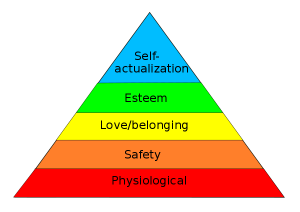
But, here’s my small take: I think the issue of climate change and why people seem to react they way they is down to framing and that the messaging doesn’t use Maslow’s hierarchy of needs well, if at all.
From this I believe that the messaging may lack resonace, because of the human’s reptile mind to rationalise impending threats and considers it “well it doesn’t impact me”. This is where I think framing and Maslow’s hierarchy of needs can sit.
Thus, if the messaging used framing, and presented its message from a needs statement, then it can offer a much more promising impact, and garner the results needed.
Of course, this assumes good actors on both sides.
With so many motivation books out there, often you will find they repeat the same message ad nauseam, “have a vision, have a goal, work hard and smart, mind mentors, a mastermind group; find a team, out work the competition, have passion in what you do, your success will be earned through habits and hard work, persistence, etc”. So, given all this does this this book stand out of the crowd?
The truth is no, no it doesn’t. At best it consolidates the better information into a digestible 165 pages, something that can be read in a day. It comes with things to fill out; but apart from these, you will find it will often repeat the same mantras, buzzwords and zeal that these other books do.
The most value I got from the book, and that’s not saying much, is the insight that year long goals feel far off the distance and do not much the needle much, its much better to have smaller time frames such as 90 days.
Given this, I think having a 90 day challenge and following a 1-3-5 methodology with an accountability partner (be it a mentor or friend) or alternatively you track your progress every day might be a much simpler and much more approachable way for solo business owners.
Overall, I didn’t like this product at all. It reads like a sales letter for his website. Lots of power words and self help like language. It has some interesting tidbits, but these are few and far between.
The book is mostly a self help guru book that is designed to move you to his website, and feels like a published Kindle booklet/pamphlet than anything that might be of any use.
This is a book review for “6 months to 6 figures” by Peter Voogd, this review has not been paid for.
“Despite its title, 6 months to 6 figures has very little information on how exactly to get 6 figures in 6 months”
Peter Voogd’s track record of success over the past 10 years is amazing and certainly worth reading up upon. Having trained and led over 6,000 entrepreneurs from students all the way up to business owners is just one part of his success story.
Peter’s journey began in his early teens when he first made his first six figure income, and has gone from there to become an influencer and innovator in a number of business areas.
Although he isn’t that well known in the UK, I decided to give his book a go, it seemed reasonably priced and I was intrigued about the content of the book, especially considering its click-bait like book title.
The book is about 150 pages long and can easily be read in a day, if not shorter and is, broadly speaking a book in three main parts:
Motivation and mindset
Getting a team / mentor / mastermind group
A 30-day challenge
Disappointingly, despite it’s title, 6 months to 6 figures has very little information on how exactly to get 6 figures in 6 months.
I bought this book because I was under the impression that the book would lay out a number of markets, verticals, or channels where I could make 6 figures. Or alternatively would lay out a roadmap blueprint of activities to follow.
Instead the book is a self help book with a number of opportunities for you to fill in forms to get you thinking about your position, your direction and your next steps.
However, there are a number of things I was perhaps unhappy with regarding the book.
I was expecting the book to be specific about the channels, verticals or markets someone should get into if they wanted to get 6 figures; it hardly ever does this. Nothing about retail, nothing about sales, nothing about real estate. There is a big push for multiple channels of revenue; but doesn’t state (except in one bullet point list) what areas to focus in on.
It doesn’t state any activities that you should be doing, or what people you should be contacting. Perhaps the closest it gets is the habits you need.
The main issue I have is that it reads like a sales book for his website, and other materials. Whilst these materials are (as of time of writing) free, it does put the reader off.
The positives I have are about the book is that it is double lined spaced, short and gets to the point; its an easy read with clear legibility/readability. The chapters are quick, fast and don’t stay around too long.
Each chapter has a number of forms that you can fill in, and each focuses you on your specific goals, your position, where you want to be and what is holding you back.
Whilst these are indeed useful, and a bit different to other books; I think this should only form as part of an appendix, and the book should have focused more directly upon the 6-figures concept, what verticals get you there the quickest.
I do like the book, its better than his other book, and I perhaps will re-read it again; but I’m not sure I’d recommend it as a roadmap; but its more of a sales book and self help book than a directive book.
This is definitely reads like a sales letter for another product, and readers should be aware not to expect a roadmap, or markets to look at, or activities to do to make the advertised six figures in six months.

![Entrepreneur's blueprint to massive success [Book]](https://silentflute.co.uk/imgs/2019/05/book-massive-success-200x300.jpg)
![6 months to 6 figures [Book]](https://silentflute.co.uk/imgs/2019/05/book-6months-6figures-200x300.jpg)