Author: Amo

  • Greed Incorporated (2006) – Boardgame Review

    Greed Incorporated (2006)

    Link: https://boardgamegeek.com/boardgame/55952/greed-incorporated

    Publisher: Splotter (2009)

    —

    “Greed is good” – Gordon Gekko

    Published by Splotter in 2009, Greed Incorporated sets 3-5 players in the world of high finance and economics as corporate investors or corporate raiders who are, in my words, actively trying crash companies in order to get a big-time severance pay and use this cash to buy fancy executive toys (ie. Private jets, or Premier League football clubs).

    Thus, unlike in other economic games, players do not win with the highest cash, but rather; the most victory points!

    By most comparisons, the game is very rare, and can easily fetch around the £60 – £150 range on ebay or boardgamegeek; but does it’s rarity and high price really equate to a good game?

    Let’s find out…


    Played over approximately 10 rounds (dependent on number of players), players will run one, or multiple companies; and try to increase their respective companies cash or actively try to trash a company and walk away with a big-time severance pay.

    To do this, players will play 1 card per round; this card will affect the trend and market price for up to 11 different types of goods (ie: Land, Sand, Cotton, etc).

    Prices will be adjusted, dependent upon their trending position (ie: -3, or +2).

    An example:

    Cards
    Some of the asset cards from Greed Inc

    On the example image it shows a few asset cards; and an icon at the bottom shows the change in trends, which in turn will affect the price of the goods.

    Market board
    The main market board in Greed Incorporated

    Once players have played a card, players will bid on the asset cards; adding it it to their corporations’ placard.  This placard will track up to 4 assets, the people within the company’s structure (ie: CEO, CFO, COO) and 3 piles of cash: 

    • New income,
    • Last year’s income, and
    • Free cash

    With exception of free cash, a player may not spend or use New income or Last year’s income. 

    Interestingly, these 3 piles are a mechanic in the game; where if your company did not make more income than last year – somebody will be fired.   It doesn’t matter if you broke-even.  The only thing that matters is pure profit!

    Indeed, it is when you can’t make a profit that someone will take a fall; during this process, a player may walk away from anywhere between 40% to a maximum of 80% of the company’s free cash.

    When a company does crash, payouts will occur and a corporate restructure will take place; meaning that a player may lose control of their company and a new owner will be decided.

    Planning out who will control a company when it falls can sometimes be an interesting decision:  Do you want to remain in control of a poorly run company when it crashes?  Or, do you want to offload it so that you can funnel that cash and efforts elsewhere?

    Walking away with cash is always tempted.  Indeed, a player’s private cash is the only cash that can be used to purchase VP cards (ie: Private jets, etc); and more interestingly, you can only buy 1 VP card per round.     So timing your company’s crash becomes important, you can get VP early; or wait to get VP when they get better.

    So, after about 10 rounds – whomever has the most VP is the winner of the game.

    Components

    The component quality is very basic, but gets the job done.

    Paper-money, lots of cubes, big-boot markers and a few wooden dollar symbols are all you seem to get.

    There are a bunch of cubes which mark all the different 11 goods, and their respective trend (ie: Land could be trending: -3, 0, +1, +2) and are placed on the main game board, as described earlier.

    Rule book

    Serviceable rule book, seems to explain most actions quite well; be sure to read the Errata.

    The rules also includes a grid which is used to calculate the severance pay for players who crashed their companies, split into two columns: 40% and 20%. However, I recommend writing a simple Javascript app that will do all the necessary calculations for you; and display all figures required.

    My thoughts of the game, and why I eventually sold it

    Having played Greed Incorporated about 5 times, I’m in two minds about the game.

    What I enjoyed:

    The theme, negotiation gamesmanship are all enjoyable. The speed at which the game moves a long can be quick, or slow; dependent upon deals. There is little AP; as all items are public (except perhaps a player’s private cash); so you know what people can produce and all you have to consider is what deal works for you and your multiple companies.

    “Growth! Growth! Holy growth!”

    I really liked the mechanic / narrative that your company must always make a profit, a not simply good enough to break even, you got to beat last year’s expectations!

    I even liked how it didn’t even matter if your company has got over a billion in your free cash; shareholders are only happy if this quarter if you beat expectations.

    Bill Maher highlighted the idea of “growth at any cost” in a 2016 video, which I think neatly reflects this narrative.

    “In corporate America, the stock market is the tail that wags the dog — growth! growth! holy growth is the only thing that ever matters. Better than last quarter! Beat expectations! Eat more hamburgers!”
    url: https://youtu.be/y4X3OSd6HzY?t=209

    I also enjoyed the 18XX style trading mechanic, where you could run up to a maximum of 3 companies and then trade between the companies (ie: Buy Land for $1, then Buy it back again for $100).

    What I did not enjoy

    The game is incredibly linear.  The story, narrative, flow of the game is always the same.  It has only really got 1 main gimmick, and once you’ve seen it; there is very little reason to play the game.

    Despite the idea that you are trying intentionally to crash companies, there never seems to be enough time to do this; and the number of new companies to establish is strictly limited.  This means players need to balance building an engine verses building points, and rarely do you get options to do either.

    There is this notion within the game that speaks to “we want you to crash companies” but then on the other side give you limited tools to accomplish this goal.

    Further, for novice players its very easy to eliminate yourself if you crash your only company and have not enough cash to buy a new company and have to wait around to establish a new one.


    Pros:

    • Strong theme with strong economic and financial ties.
    • Can play fast/quick; but is dependent upon player’s time for deal-making.
    • The game feels like it has something to say about its theme

    Cons:

    • The game is pretty rubbish at 3 players; you NEED to play it with all five players, the more actors mean more opportunities for deals.
    • Feels like there is not enough time to build your engine
    • The game setup is always the same, and other than the variation of the position of the numbered cards within the brackets (10-20, 20-30), there is no modular setup.
    • The game’s narrative is always the same. Prices go up, eventually they fall.
      I feel there are better games about acquisition out there. Acquire is better, some of the lighter 18XX games are better.

    Is it worth buying?

    • Only if your a collector. It certainly (as of time of writing) holds its value.
    • Only if you want to complete your Splotter collection
    • Only if you like economic games with negotiation

    Is it worth playing?

    Yes.

    Play the game. Its worth it, just to understand the flow of money in the game and what the game’s storyline is.

    Overall thoughts

    I enjoyed the game, I did like its narrative and trading and negotiation elements. What I didn’t like is how every game felt the same and the decisions you made, the story flow of the game was very linear. But I guess it has to be that way for the game to weave the story it’s trying to tell.

    Bottom line: Play the game. I just am not sure if its worth buying it, unless you are a collector or need to squash the bug that wants to know if the hype lives up to the delivery.


    Overall: 7/10

    Link: https://boardgamegeek.com/boardgame/55952/greed-incorporated

  • The Psychology of Selling (2005) Book review

    The Psychology of Selling BookA very poorly written book about sales.
    I read the book in about 1 day, its a pretty worthless book.  It has very little to do with the Psychology of Selling at all.

    –

    I was very excited by the chance to read “Psychology of Selling” through my local library, and I was very excited to read it given Tracy’s background and name recognition in the industry.

    However, having completed the book in practically one day, I felt the book was incredibly lacklustre. The book was more about self improvement, a self-help book dressed up as a sales book.

    It wasn’t even about psychology (where are maslow’s famous hierarchy of needs?), or even sales. Its not even pop-psychology and I would definitely not recommend it as either a sales book, or a self-help sales book. There are better books on the market.

    When you compare “Psychology of Selling” to “Spin Selling” by Neil Rackman (An actual Psychologist of 25 years experience), you’ll agree that its night and day in comparison. Rackman methodology goes through different ideas, methods and techniques and explains them; whereas Tracy gives a passing reference to an idea, dresses it in so much new age self improvement jargon that you may even forgot this book was meant to be about Psychology of Selling, not Psychology of self improvement.

    Yes, Tracy does cover the 80/20 rule, covering that through prospecting, building rapport, doing a thorough needs analysis of your product/service and the customer’s needs can help identify and turn prospects into winning sales.

    Further, Tracy states to set goals, daily, weekly, monthly sales; stay on target, achieve your goals, use vision boards, plan your calls ahead, and look at the reasons why people might buy your product (is it out of fear, greed, prestige, etc); but the problem is Tracy doesn’t give you actionable items to do, except to set goals.

    Whereas Tracy argues that the best time to make a sale is right after a sale, and that prospecting via the phone is not a luxury, but a necessity; he seems to categorize the customer as somebody to be sold to; and forgets something that Rackman and others (including New Rules of Marketing author David Meerman Scott) in his book “SPIN selling” readily identified some years ago, and that is — the customer has changed, and the old ways of selling are dead.

    Customers are sophisticated, and the way business target, market and reach them have changed; so has the way business sell to them. The image characterised by Tracy as a Business person whom is trusted, is dressed for success and uses buzzwords mis-judges the customer. As many authors have noted, some customer-business relationships demand trusted partners, and the journey of a customer should be explored.

    As a final note, I want to state that I felt that this book really missed a lot, it felt like another self-help sales book, there was very little useful in this book and would not recommend it to anyone serious in getting into sales at all and would recommend SPIN selling, New rules of marketing and PR and other more seasoned, tactic-based sales books on the market.

    Link: The Psychology of Selling (Amazon)

    Editor’s note: Link is not monetised.

  • Why does travelling to Sunderland by public transport take so damn long?

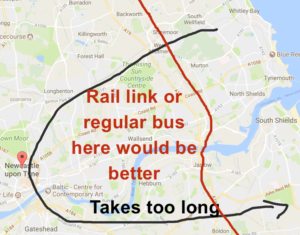
    Tyneside Map

    If you live in Tyneside area you’ll know that its a real pain to get anywhere south of the river using public transport. Your only options are to sit on the Metro for 45-90 minutes as it stops at every stop going around the system before you finally get to your destination in Sunderland; worse still if you happen to want to go further south to Middlesborough or further afield.

    Sure, we have services like buses and the North Shields ferry; but to be honest these are really slow and not suited to regular, commuter passenger journeys. In the end, Metros or changing buses are the only option; and to be frank the journey times are joke.

    Journey’s take should 30-40 mins end up taking anywhere between 1-2 hours by public transport.

    For the past ten or so years I’ve tried to find quicker, faster routes to go south from anywhere East of Newcastle; bus hubs like Four Lane Ends offers no southern bus routes and the only irregular bus services are in North Shields which travels via the Tyne Tunnel to Jarrow; thereafter you are needing to change again for another service.

    In the past there used to be the 319 bus service that ran from Cramlington to Sunderland; and for me I found this journey was faster and cheaper than the Metros.

    Getting limited stop, express buses from Sunderland to Newcastle are also a pain. There used to be the X4; but sadly this no longer exists and the so-called express buses from Sunderland are nothing of the kind, stopping at virtually every stop.

    Of course one could use the National express bus service; these are dedicated services, but these are not practical for regular commuting.

    So what’s the answer? For me, for a quick win would be this:

    Put on more bus services that run through the Tyne Tunnel

    With the duelling and upgrades the A19/A1056 roundabout system, I see why services cannot start running through the tunnel, servicing the south using a limited stop service.

    But a more bolder approach would be;

    Build another rail station in East Newcastle, nearer to Whitley Bay

    This would mean creating a new Tyne Tunnel for rail services. Why not a bridge? The river is used regularly for maritime industries and the space is required for large vessels to traverse the River Tyne.

    I’m not sure if its logistically possible, or if the foundational bedrock under the River Tyne would support such a tunnel, but when I look at the Billion pounds invested in London’s cross-rail services; one can easily think — why can’t we have that?

    My own crappy drawing relies on the old rail lines that existed in the area; most of this is now walking areas and perhaps is impractical or unrealistic or would cause a local uproar to re-appropriate this for rail lines.

    A new rail station in the East would do so much to reduce traffic, and create a hub for public transport and cut journey times by half.

    Perhaps I’ve played Transport Tycoon too much, perhaps I look at the CrossRail services in London wondering if the North East will ever rebuild its networks; but regardless, I still believe a better infrastructure, even if its with direct, limited stop buses that traverse the Tyne Tunnel would be still be a better option than sitting on the Metro or forcing all public transit through the centre of Newcastle upon Tyne.

    Just my two cents.

  • Fixing Blofeld

    blofeld

    “Spectre”, the 24th installment of the James Bond movie franchise movies saw the re-introduction of Ernst Stravo Blofeld. The noted arch-vile and mainstay villain of the classic 1960’s Sean Connery James Bond movies was rebooted for a modern era and audience.

    However, as many reviewers and commentators have stated; this version of Blofeld, played by Christoph Waltz, had very little to do in the movie; and that his character was in-developed or lacked any menace.

    Indeed, I’m struggling to remember what Blofeld’s plan was in Spectre; only upon reading on Wikipedia I was able to find out that his overall goal was to standardize and monopolized the spying sharing network “Nine Eyes” for monetary reasons.

    Many reviewers, including myself hated the reveal that “Franz Oberhauser” was a step-brother relative of James Bond.

    Amazingly, this reveal of being step-brothers (or relatives) was used earlier in the Austin Powers’ movies; and the irony of this was not lost on many IMDB reviwers; considering how many within the Bond franchise had complained that Austin Powers’ had effectively emasculated and parodied any serious attempt to recreate Blofeld even before the thought of rebooting him came about.

    A further blow came when Blofeld revealed “I was behind everything” force-patching the villain in every previous Daniel Craig James Bond movie was forced and, on the whole, didn’t make sense and again lazy.

    Perhaps it was the writers need to patch everything together, the producers desire to make a cinematic universe to rival the on-going Marvel super-hero movies; or perhaps the Sony hack back in 2014 where the leaked script had to force writers down another path had lead to a poorly drafted Blofeld and a poor addition to the continuing James Bond series of movies.

    On reddit, the rumors that the next James Bond movie will see a returning Blofeld and will follow plot points from the original Ian Fleming novel of “You only live twice”; that being Blofeld takes the pseduoname of “Dr. Guntram Shatterhand” and Daniel Craig’s James Bond is on a revenge mission to finally kill him.

    And yet, I believe Blofeld can be fixed; albeit my idea of Blofeld’s background could have been better.

    Make Blofeld a product of the CIA that went wrong

    Fundamentally, I’d preface Blofeld a product of the CIA with the vision to ask; can the power of a state in an individual become a danger to the state?

    I’d have written Blofeld as a product of the CIA, and a child of the CIA MK-Ultra project; the codename given to a series of illegal human and child experiments undertaken by the Central Intelligence Agency, used to manipulate people’s mental states, altering brain functions, and the usage of drugs, sensory deprivation, isolation and verbal abuse, as well as other forms of psychological torture.

    Imagine the relationship we saw in the James Bond movie “A View to a Kill (1985)” where Max Zorin had a subtle relationship with “Dr. Carl Mortner”; but on steroids.

    I imagine that Blofeld would have fallen into a psychological trap of Stockholm syndrome with a domineering CIA “father” figure.

    Similar to how in the movie 1978 movie, “The Boys of Brazil”; I believe that Blofeld’s background could be moulded by an “Dr. Josef Mengele” type individual, whom has a mind-set of creating a world figure; that they themselves controlled ten, twenty years prior.

    Perhaps taking cues from the “The Parallax View” (1974); James Bond could investigate the historical routes of
    a multinational corporation that has links to Blofeld; and its found that a former majority shareholder was the principal architect behind Blofeld’s rise on the world stage.

    These tactics of Gaslighting, and “Divide and conqueror” would explain SPECTRE’s own tactics and where the formualised ideas and strategies came from.

    TLDR;

    In short, I see Blofeld as a troubled child that turned psychotic and twisted after realising he was remoulded by a shadowy CIA MK ultra project to craft him as a world leader; a Maitreya-esque figure, “a teacher” that created a SPECTRE in order to shape world opinion; as a reaction, a measure to take revenge on the world that blighted and a life stole from him.

    I would ignore all ideas that Blofeld was related to James Bond; and perhaps “Franz Oberhauser” was indeed Blofeld’s original name; but Oberhauser took his “father’s” name, the name of Ernst Stravo Blofeld from his CIA handlers.

    I believe that creating a solid foundation of what, who and why Blofeld exists and what his reason for being can be crafted; then his subsequent villainy, and evil can be treat the character as as serious comment on whether enemies in the mirror are any different to enemies in the shadows.

  • Throw away your metal Indian club bells

    metal club bells

    Often hyped as “Indian clubs”, the metal club bells found on the Internet and some retail shops are often used for swinging motions to help strengthen, build and improve stability issues in the shoulder; such as the rotator cuff.

    However, having spent some time using the Wooden indian clubs, I can say that the metal power club bells are horribly designed and should not be used. Ever.

    The ones I have are small 2KG metal ones and find them very heavy and cause pain and pressure on the wrists; they are not designed to be swung at all.

    Indeed, I’ve decided to throw away my metal club bells in favour of the Wooden Indian clubs.

    Why? To put it simply, they are not indian clubs and they are poorly designed, the weight distribution is incorrect and even the 2KG ones are too heavy and bulky for anything other than simple curls and forward motion swings.

    I find that the wooden Indian clubs have the weight distribution correctly placed in the head of the club and more motion, swings and yes; even tricks can be used — further, they have a strong historical pedigree of being used throughout the Indian sub-continent, Victorian Britain and a lineage in the British Navy and other, related armed forces.

    In short, throw away your metal indian club bells or at the very least try and compare them to Wooden ones and you’ll agree that well designed and formed wooden ones beats the metal club bells any day of the week.

  • Swift 3 – Using .map to walk through and create an array of items with offset

    Sometimes I want to create a quick way to add a number of items with a name; such as creating 10 decks with an offset number.

    Usually this can be done like this;

    // usual way;
    var decks : [Deck] = [Deck]()
    for idx in 1...10 {
    decks.append( Deck.init(name: "#\(idx)") )
    }

    But I find this functional way a bit better

    // functional way
    let decks = (1...10).enumerated().map({ (offset, element) in
    return (Deck.init(name: "Deck.\(offset)"))
    })

    Although my usual way is memorable, I like the functional one as its a bit cleaner and uses less code.

  • Locomotive Werks review

    Locomotive Werks Box

    Buy Locomotive Werks Board Game on Amazon

    Published in 2002 by Queen Games and designed by Dieter Danziger, this economic game pits 3 to 5 players as investors in building factories that produce locomotives and aim to sell them to a dice-driven market where turn order is critical.

    Locomotive Werks’ main gimmick is “obsolesce”; the idea being that the demand for older trains dries up, often at a very quick pace to the point where older trains become removed from the game entirely.

    This mechanic is often referred to as the “Train Rush” part of an 18XX game.

    So how is the game played?

    The game is a race for coins, specifically, 300 coins (its actually 330 coins once 10% tax is added on); whereafter the game will end and the player with the most coins will win.

    Player’s play in a sequential turn order flow in rounds which are split into 5 phases which are: Purchase Locomotives, Purchase Production, Selling, Pay Taxes, Market Demands.

    The first phase is allowing Purchasing Locomotives, where players have the option to buy a new locomotive factory plant; however they can only buy 1 factory and can only purchase each factory once.

    Further, if its the first to be purchased; then the next factory will become unlocked and available to buy.

    This can cause a chain reaction where players will often buy the next factory because they give a better return on investment.

    Once all players have completed this phase, players move to the next phase: purchasing production.

    Players will go in turn order and optionally choose to buy production units.

    Players must weigh up whether they will be able to sell their production and how long their investment will make a return.

    After purchasing production, the next phase is Selling; this phase is 100% automatic whereupon all locomotive factories sell and fulfil the demand as per the die roll they have; giving the players owning those respective factories a financial payout. Except sometimes, dependent upon die rolls and demand fulfilment, some players may not get any payout at all; and this is where player turn order becomes important.

    Once everyone has sold, everyone will pay taxes of 10% rounded down; so if you have 10 coins, you’ll be paying 1 coin as a tax.

    After tax, if any player has over 300 coins; then the game is ended, with the winner being the most coins; if not, then the game will continue play.

    The final phase is Market demands, where new orders are given and older generations start lose demand and slowly become obsolete.

    For example, if there are 2 green generation train factories on the market; then the older factory will steadily lose dice and lose potential orders to the point where it has no orders at all and is considered obsolete.

    Worse still is there are 3 green generation factories in play then the eldest locomotive train is removed from the game.

    Players with those factories are lumbered with produced units that they can’t sell and their only resort is to shift production to better technologies.

    So, what are my thoughts on the game.

    The game is about sales fulfilment speculation, buying production and sales turn order; with players usually aiming to grab a monopoly as they will be the only one to sell for that factory.

    There is one major downside to the game. Everything in the game is public knowledge; and feels like a game with perfect information.

    This opaqueness comes from the fact that all players’ factories, coins and ability to produce is publicly visible to all players; so you already know who can sell what, how many they can sell and whether they will sell at all!

    From this point of view, new players will feel that are hardly any real meaningful decisions; except one — will you buy production and will you sell this round, and if not this round, can you manipulate turn order to sell the next round?

    At lower player counts the ability to sell becomes even more opaque and our group felt there were no real decisions to be made, except whether to buy a factory, whether to produce or not.

    The factories are also lined up in a sequential list order; this means you know that better tech will pay out better than lower tech. For newer players; the better technology is almost always better to buy whereas the more astute players can manipulate sales turn order in their favour; even buying on factories that are due to be obsolete; just so they can squeeze the turn order further.

    This linear progression of each train’s costs, incomes and production costs further enhances the illusion that the only decision in the game is to keep buying new locomotive engines; except I feel that this is a newbie mistake.

    This opaqueness and linear progression really masks the true modus operandi of this game — its really all about manipulating turn order so that you can sell first and have certain factories with low competition.

    If players realise this, then the turn order’s importance will result in players’ buying a lot of production so that they don’t hit the tax threshold and going earlier in next round.

    However, no matter how many times I’ve played this game, people go through the motions and it sadly feels the game is playing automatically, that there are not enough hard decisions to be made and that because everything is opaque that unless people try to compete in factories you can play without humans as all decisions seem to be automatic and binary.

    Further there are no other routes to success; you have no direct impact on sales; you cannot influence it via sales people or use marketing as a way to drum up business.

    Despite all of this, I’m still drawn to playing Locomotive Werks; I see it as a good way to teach kids about sales forecasting, and also the train rush aspect of the game can be interesting every now and again.

    In all, I believe the game really only shines at 4 or 5 people; and is something I would play every now and again but isn’t in any way a game I can recommend to purchase except to 18XX and train fans.

    Overall: 5/10

    Buy Locomotive Werks Board Game on Amazon

  • Super Bodyguard (2016) – Review

    super bodyguard

    Mandarin with English subtitles
    Directed, written and produced by Yue Song
    Starring: Yue Song, Xing Yu, Collin Chou, Michael Chan
    Link: IMDB
    Link: Trailer – Youtube

    “An insane, rip-roaring, ultra-fast old-school Hong Kong action film that hides flaws in editing, poor continuity, storyline and character development.

    In this heddy mix of “comic-book” superhero action, streetfighting, drama and mindless fun; Yue Song stars as Wu-Lin, a “Super bodyguard” assigned to be the bodyguard of an unruly, unappreciative daughter of one of the richest families in the city; whilst fending off attacks from a group of mobsters.

    Wu-lin’s “super bodyguard” status comes from his “Iron Feet”, a secret martial arts technique that forces him to wear heavy iron overshoes for 10 years; which allows him to kick ass; and hard.

    In the shadows is Wu-lin’s brother; another martial artist and bodyguard business partner who is obsessed with the technique, and wants it all to himself; and is willing to go to any length to learn it.

    The brother; drunk with desire to learn the skill even joining forces with the mobsters to eventually kidnap the girl, and brutally putting Wu-lin into a shallow grave when he refuses to have anything to do with him.

    Wu-Lin’s rises from the graves, takes off his iron-shoes, and decides to wipe out the gangsters once and for all and save the daughter from any further harm.

    —

    In a movie that Yue Song himself said, “The best [kung fu] film you’ll never see” (link), “Super Bodyguard” manages to channel the best of old-school Hong Kong action movies, combining it into a heady mixture that combines evil kung-fu clans, comic-book action, hundreds of bad guys into relentless action.

    It’s clear that director, and star, Yue Song loves his action; fists, feet fly across the screen at reckless speed, almost to the point you dare not blink or you’ll miss something.

    It’s no small feat either; as Yue Song was the director, writing, producing and heck; throw in stunt co-ordination as well on this movie.

    With his strong background in martial arts, Yue throws himself into a plot that mostly serves as a thinly veiled vehicle to string together a lot of bone-shattering, fast-paced action sequences.

    And yet, there were a lot of issues I had with the movie.

    It really needed a seasoned producer at the helm.

    Perhaps it was the English subtitles, but there were a lot of times where the storyline and key scenes just jump from one sequence to another. I found it very distracting.

    There are also quite a few continuity issues with the movie too. Early on, a kid is teasing Yue Song with some ice cream as Song is doing the splits in an plaza (for some reason, its never explained what he’s doing there).

    Suddenly a van of well dressed guys turn up, the camera is now pointing downwards — but wait, where did the little kid go to? Then, in the next shot the kid is back.

    There are a number of key sequences that made me quite annoyed; they lead somewhere. Then there’s a cut and then it moves onto another scene.

    An example of this is the chase between Song and a van of hoodlums who kidnap the daughter. The sequence runs for many minutes, with Yue chasing, jumping, riding the top; its all crazy stuff — but I kept asking myself how the slowly van must be travelling for Yue able to scale buildings and urban furniture and yet still keep up with a moving vehicle.

    The whole sequence ends with Song IN-FRONT of the van, how the hell did he get there? It’s scenes like this and others similar to this that really made me scratch my head in confusion.

    Another example; later on Song is faced with a guy with a sword and a bandage around his hand. Yue walks up to him, but before we can see anything — the camera cuts, and the next scene the sword-wielding victim is on the floor.

    What was the point of that scene?

    Another issue I had was that a lot of the background story is never explained until 30-50 minutes into the movie. I found this to be very poor and could have easily been the basis of the whole movie if they did it correctly.

    There’s one quick scene where Wu-lin’s character is in his room and there are James Bond posters on the wall; I’m not sure why they are there. But it was interesting he had Pierce Brosnan’s GoldenEye and one of Dalton’s movies (Licence to Kill).

    For a movie that touted itself as the next “Bruce Lee” in some promotions, and yet in another a movie that claims to have no special effects; the movie lends itself to using a lot — and I mean a lot of wire-fu.

    Now, that wouldn’t be an issue if the story really laid out a solid foundation of why Yue Song’s character is able to perform superhero like bone-crunching moves.

    The only real explanation we get is midway through the movie; that he was abandoned, had some kind of supernatural ability and was taught by an old man; before he too abandons Yue — telling him “success needs sacrifice”.

    Even his “brother” isn’t really fleshed out; is he his real blood brother, step-brother (which is hinted at in the movie), his martial arts brother?

    I do wish they had pushed the idea of him being a step brother a bit more to beefen up the story.

    The storyline of this movie should have been “Success needs sacrifice”, and could have told the story of how the father adopts the abandoned Wu-lin (Yue Song) and quickly identifies his gift; and teaches him along side his blood-son; the story could have told it from the step-brother’s point of view about he secretly dispises his father for saving Wu Lin — and this would have helped fueled the blood feud between the two.

    There are also parts of the movie that are very rushed. The “romance” between the bodyguard Wu-Lin and the daughter; almost immediately they fall in love. Although strangely Wu-lin never seems to act like he’s in love.

    In this movie Song also has a tendency to “honour” wholesale sequences from movies he’s a fan of.

    Whilst the most obvious one is “The Matrix Revolution”; where Song is battling a load of bad guys at the same time.

    There are some other ones that I felt needed to be highlighted. Early on, Wu-lin is doing the splits in a plaza being taunted by a little kid who is eating ice cream. This is clearly similar to Bruce Lee’s “Way of the Dragon” where a similar sequence occurs.

    Later on, the whole bit where Wu-lin is failing to “protect” the daughter from a group of street hoodlums is clearly lifted wholesale from Jackie Chan’s “Police Story” (1985). But weirdly Chan’s version is better, because its background story is well developed, and funnier. Whereas here, it just happens.

    Aside from poor storyline development, poor character development and sequences that break continuity or just seemed very rushed — I thought the movie was very good, well paced and had a lot of action in it.

    It’s a movie that tries to mix Tony Jaa like bone-crunching action with Chinese folklore wire-fu action of old.

    But I felt there was a certain disconnect with the two ideas; and it isn’t helped with the lack of a decent story.

    It’s brutal, fast-paced and worth watching. One hopes that Yue Song gets it into cinemas worldwide; if it does — I certainly will be there.

    Overall: 7/10

  • Greed Inc Payout Calculator – Javascript

    This simple tool today that I wrote for the game Greed Incorporated using Javascript rather than using the payout chart

    Link: https://jsfiddle.net/worchyld/85khszq3/

  • Greed Inc Payout Calculator – Javascript

    This simple tool today that I wrote for the game Greed Incorporated using Javascript rather than using the payout chart

    Link: https://jsfiddle.net/worchyld/85khszq3/